

Ultra-Precision, Super-Speed, Zero-Error Inspection
Inspection is an intricate task as nan-portions of the product, packaging, components need to be analyzed. It is quite an impossible task to mark out every.
Updated
On this page
Key takeaways
- Inspection is an intricate task as nan-portions of the product, packaging, components need to be analyzed.
- The convolutional neural network successfully captures the spatial and temporal dependencies within an image by the application of filters.
- !Diagram: Intelligent Visual Inspection ( Maximo) Original diagram for Techfastly by Vin Patel..
Inspection is an intricate task as nan-portions of the product, packaging, components need to be analyzed. It is quite an impossible task to mark out every defect in 5 million units of products produced and packaged from manufacturing units.
Earlier inspectors had to laboriously inspect each component for scratches, misplaced parts and other flaws which was slow, expensive, and sometimes flawed leading to cancellation of orders and losses for the organization.
Then came automation of inspection but human levels of judgment for detecting flaws was lacking. Finally, cognitive visual inspection with its high precision defect detection and advanced algorithms for detection of flaws of various types in real-time, made entry into the scene.
Cognitive Visual Inspection saw companies quickly matching industry 4.0 standards and having zero-defect products as the end result of manufacturing. Approved orders of products, reduced cost in inspection and increase in revenue with maximum clients satisfied is now becoming the norm with application of cognitive intelligent visual inspection.
Some areas where visual inspection is used in industries:
Original diagram for Techfastly by Vin Patel.
Unless and until there is consistency and quality in every unit manufactured, you can’t gain that level of client trust and may even lose orders from clients. Cognitive inspection has come to the aid.
Original diagram for Techfastly by Vin Patel.
(Source: https://nanonets.com/blog/ai-visual-inspection/)
Adoption of cognitive inspection capabilities in manufacturing helps in
· Improved quality of the product
· Defect detection in real-time
· Minimizing chances of human inspection errors
· Ability to scale inspection easily with an increase in manufacturing capacity
· Reducing the time involved in the inspection
· Improving the manufacturing yield
· Increasing the process throughput
· Reducing the training time for inspectors
· Combining visual and acoustic data to have better defect recognition
· Easy classification of defect type, location along the production line, and severity
· Ensure prescriptive maintenance of the manufacturing and proactive monitoring of defects
· Supports frequent up-gradation of the product models
· Helps in monitoring whether the process input and output variables are within the desired range and thereby help in calibration of equipment and pieces of machinery
· Pinpoint functional deficiencies in the manufacturing process
· Detection of minute errors like tiny scratches or pinhole like defects that can’t be done with manual inspection
· Can be easily applied on factory floors via edge devices
Below I have mentioned the series of steps that can be used for cognitive visual inspection of products in the manufacturing
- IoT Installed Cameras
IoT installed cameras must be present at the beginning, at various stages in the production process and the end of the processing line. These cameras would be used for getting high-resolution images of various raw materials and components going into production, ultra-clear images of various stages of the finished products.
Robot mounted cameras #
If the cameras are robot mounted with movable parts, they can help in
· Easy relocation and placement along the production lines
· Autofocus of cameras through easy movement towards and away from the products
· Lesser number of cameras required
· Inspection of products, detection and robot-aided sorting and functioning in real-time
· Easy adjustment of the angle of installation for best images
· Minutest details can be detected
Original diagram for Techfastly by Vin Patel.
(The American Society of Mechanical Engineers- )
The various essentials for getting ultra-clear focused images and better ML model training would be
Lighting on the product #
The focus of the cameras on the various parts of the product (based on defect areas emphasis). Consistent, high-fidelity images are required for interpretation.
Pre-processing of image #
It is not mandatory that the entire image would be useful. It is necessary to remove the unnecessary content and filter out only those portions that would be used for defect calculations. For this filtering techniques must be employed to capture the essential parts under consideration.
Multiple data sets for better training #
There should be a collection of multiple batches of image data for training the machine algorithms. Multiple sets of product samples at every stage of the production must be labelled defected and defect-free.
- A product is an Assemblage of Many Unfinished Products
A product goes through various stages of unfinished products. These unfinished parts also need to be defect-free so that the entire product is defect-free. So, images at every stage of the manufacturing are required.
For example; in toothpaste manufacturing, we need to ensure that the tube is of equal lengths (if not that would be considered a defect). Similarly, the caps manufactured must have equal width, and depth, the nozzle must have an equal number of screw engravings. These parts are manufactured separately but a defect in any of them would result in rejection of the product finally.
So, multiple images labelled (defect and defect-free) from various stages of the manufacturing process need to be collected.
- Image Classification and Training Your ML Models
Image classification done in the rightmost manner would help create better quality data sets for your training model.
For image classification, deep learning algorithm and Convolutional Neural Networks (CNN) are used. It classifies and processes images just like neurons in our brain. Neurons are present in the visual cortex of humans’ processes and classify images in layers. Not only this, response to stimuli by individual neurons occurs only within a limited region of the visual area and is also known as the receptive field. Collections of such receptive fields overlap to cover the entire visual area. The convolutional neural network successfully captures the spatial and temporal dependencies within an image by the application of filters. CNNs have similar methods of classification as other traditional supervised learning methods
Input images are received, the features for each of them are detected and then a classifier is trained. CNNs do all the hard work of feature extraction and description and learn the features automatically. The input layer accepts the image pixels as input in the form of arrays.
Original diagram for Techfastly by Vin Patel.
The first layer – The convolutional layer identifies the different set of features from the sample input images
The Pooling layer- The pooling layer reduces the size of the image while retaining its all-important features for analysis and calculations. It is generally present between two convolutional layers. It receives image input as feature maps and then applies pooling to them
The Rely Activation function- Rely stands for rectified linear activation unit. It is an activation function that enables neural networks to consider non-linear relationships. ReLus add non-linear transformations to the output response of the fully connected layers. The fully connected layer detects and classifies the input image and returns a vector of size K, K being the number of classes in the task of image classification
CNN architectures help in semantic segmentation. Semantic segmentation is the process by which an image is divided into related, coherent objects in a way that each pixel in the image is categorized as being a part of the original product. It helps in comprehending the meaning and the content of the image.
Original diagram for Techfastly by Vin Patel.
4. Training The Model To Count Products And Their Distance From Critical Areas #
The model can also be trained to count the objects and their distance from critical areas based on the size of the images and clarity
Original diagram for Techfastly by Vin Patel.
5. Aiding The Cognitive Inspection With Sensors #
Vision sensors can be used to detect various kinds of product features and send data for training to the ML model along with cameras.
· An area sensor can be used to detect the features which are missing in the fabricated part
· Blemish sensors can be used to detect scratches on the product or the package surface
· Match sensors can be used to detect variation in label placement on the product or the package
· Line scan sensors to take snapshots of moving product units along the production line. They are sequenced with the speed of moving products
There can be many other sensors that can be used in the manufacturing process. They are all different programs for detecting different aspects. Coupled with IoT installed movable arm cameras, they generate tons of vital data sets for ML model training.
The aim is to provide the best image data from various stages
6. Induction of Cloud in The Cognitive Vision Model #
Traditionally Machine learning requires local hardware to manage the spike in computational demands. With cloud inducted, the storage and the computing tasks of image recognition and classification can be handled more comfortably and flexibly.
7. Creation of an Analytic Library of Defects #
Creation of analytic library of defects from hundreds of image data sets helps in better labelling of the images and better training your ML model to identify them in the pipeline. Machine learning goes over your library and validates its algorithm for accuracy in detection, over a larger number of data sets. Large data sets of images of different types of anomalies and damages improve the system’s visual recognition capabilities.
Original diagram for Techfastly by Vin Patel.
The industry model for cognitive visual inspection would look like the following:

Original diagram for Techfastly by Vin Patel.
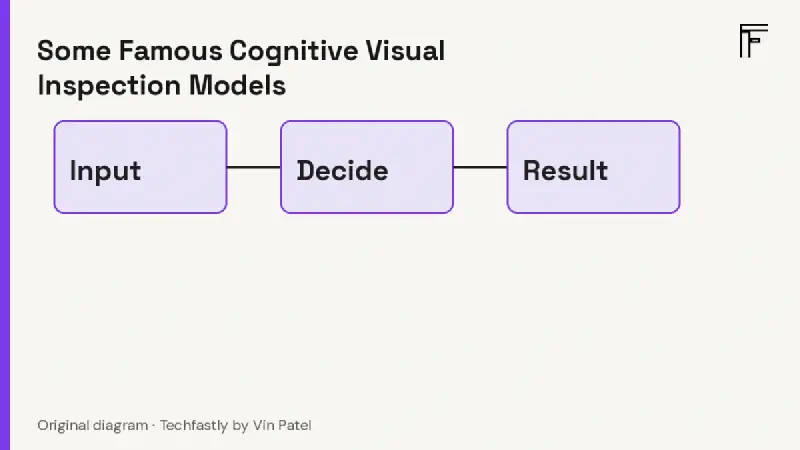
Some Famous Cognitive Visual Inspection Models #
Vision AI ( Google)- It helps you train your machine learning model according to your business needs with Auto ML vision. You can import your data set to Cloud Auto ML of Google, train them and generate predictions with Cloud Vision Rest API.
How it works? #
Original diagram for Techfastly by Vin Patel.
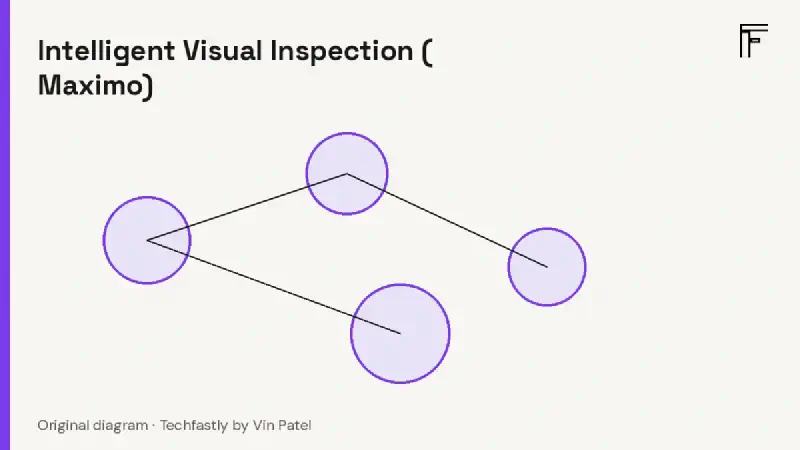
Intelligent Visual Inspection (IBM Maxim) #
Here the camera captures product images and feeds them to Watson for interpretation and analysis. Watson can detect defects as minute as tiny scratches or as small as a pinhole. It also nan-detects the shape, color and location of the images.
How it works? #
Original diagram for Techfastly by Vin Patel.
Related reading