

Hubble's Remarkable 31 Year Journey
Even today, as it speeds its way, at 17,000 miles an hour, the first major optical telescope to be placed in space is expanding scientific vision day after day.
Updated
On this page
Key takeaways
- Even today, as it speeds its way, at 17,000 miles an hour, the first major optical telescope to be placed in space is expanding scientific vision day after day.
- The years that followed saw the LST encountering many setbacks.
- With a few more years until its orbit decays and NASA takes the call to crash the telescope, we too cannot wait for what this trusty old ‘eyes in the skies’ is getting ready to reveal.
From supernovas to charting the effects of dark energy on the universes growth, and from capturing the distant moons to photographing thousands of galaxies to reveal galactic evolution; The Hubble Space Telescope is, as NASA terms, “the most important advance in astronomy since Galileo”.
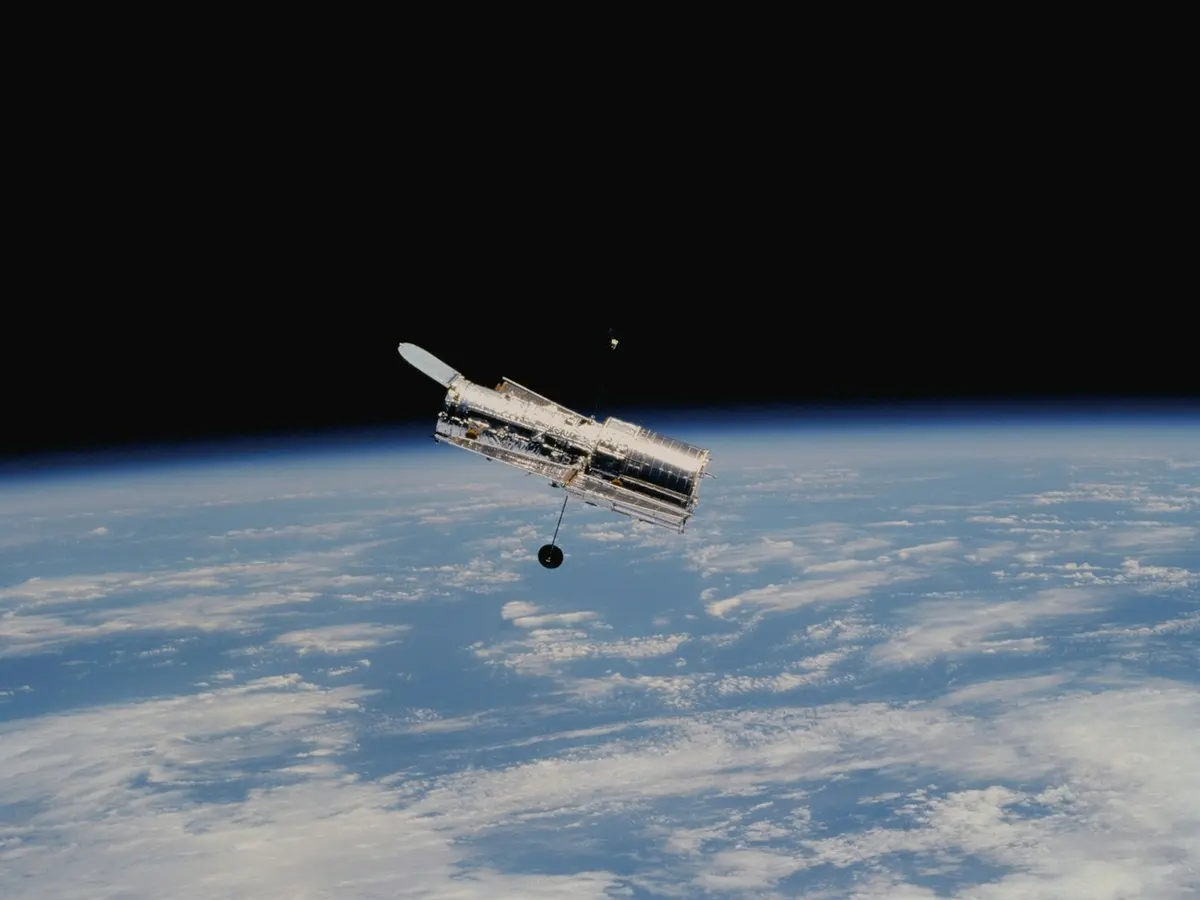
Amidst a plethora of galaxies and distant stars, Hubble makes its quiet orbit around the Earth. Even today, as it speeds its way, at 17,000 miles an hour, the first major optical telescope to be placed in space is expanding scientific vision day after day.
Since its launch in the 1990s, Hubble has consistently lifted a shutter from our view of the universe. In fact, it has changed our perception so profoundly that humans have never been able to look at the stars in the same way again.
But as many, who were initially tasked with getting this scientific wizardry to the skies, would agree - the going was not easy.
Murky Sight – Glasses, Anyone? #
The life source of the planet, our atmosphere, acts as a translucent veil blurring our vision of the skies. Moreover, it does not help that the atmosphere is in constant flux, causing the light from the heavens to shift and wiggle as it reaches the naked eye. Did you know it’s this wobble that causes the twinkling of the stars?
But on a photographic plate, this twinkling, in turn, causes the accumulated light to spread out so that a genuinely sharp image is just not possible. Trapped underneath the Earth’s unsteady atmosphere, early astronomers had to contend with looking up at the skies as if they had a terrible vision and were forbidden to wear glasses. In effect, up until man conquered parts of space, both professional and amateur astronomers were never sure of what they saw.
A determined lot that astronomers are, they built more gigantic telescopes, some even perched on mountain tops, where the atmosphere is thinner. But even then, our brains refused to comprehend the fuzzy and distant images it perceived from the comforts of the ground. As a result, our theories on the universes expansion, its birth and its evolution were sound, but the data to support it was not good enough.
But as fate would have it, one man would take the first steps in what would become an ambitious half-century-long saga to solve the age-old dilemma that astronomers had been facing. This man was about to propose that the United States build the first optical telescope – in space.
Inspiration For An Orbiting Telescope #
In 1946, Lyman Spritzer Jr published Appendix V of the Douglas Aircraft Company’s Project RAND. The title of the work was “Astronomical Advantages of an Extra-Terrestrial Observatory.”
As he later summarized, “While a more exhaustive analysis would alter some of the details of the present study, it would probably not change the chief conclusion that such a scientific tool, if practically feasible, could revolutionize astronomical techniques and open up completely new vistas of astronomical research.”
He was not the first to suggest such an idea. Still, in comparison to works of his predecessors, his paper was concrete, realistic, and based on technology that was either available at the time or expected to be developed in the coming decade.
But for many, it was still an audacious idea, especially given that, in 1946, the 200-inch Hale Telescope on Palomar Mountain in California, soon to become the world’s largest ground-based telescope, was not yet finished. It had taken almost three decades to build and would weigh a million pounds. Now imagine carrying that load into space on a rocket that remained firmly rooted in the realms of science fiction.
Through the ’40s and the ’50s, Spritzer struggled to garner interest in his space telescope idea. But on October 4, 1957, everything changed.
The Beginnings Of Space Race #
On that day, the Soviet Union launched Sputnik, with a diameter of 22 inches and weighing 184 pounds; it circled Earth once every hour and 36 minutes. The launch of Sputnik sent shock waves through the intellectual and political communities of the United States. In a rush to match their Soviet compatriots, NASA was formed, the Mercury program was instigated, and President Kennedy declared to the nation that the United States would put a man on the moon by the end of the decade.
For astronomers, the sudden interest in a Space program proved to be a boon. Plans for several projects that would help get a better view of the universe were recommended. Still, the balance between cost and benefit remained elusive, and the endeavors failed to find credence.
However, by 1965, the “Sky was the Limit” for NASA. The Gemini program, proposed in 1961, was putting two men in orbit every two months. In addition, they had launched three Ranger probes to the moon and had also sent a rover towards Mars.
So, when in 1966, Lyman Spritzer chaired the working group on astronomy with fellow space enthusiasts, everyone’s mind was ripe to receive the idea of building a large orbiting telescope. Plans to construct one in conjunction with the manned space program were ultimately reached. In fact, the astronomers were in such agreement that a lighthearted discussion on its name took center stage, and after some good amount of jest and, of course, complaining, a decision was reached.
The telescope would eventually be called, precisely what it was - “LST – Large Space Telescope”.
The Build Up Towards The Launch #
The years that followed saw the LST encountering many setbacks. From rising costs to the projects brief cancellation, the telescope faced pretty much every roadblock for a venture of its size. Eventually, the LST was slated to be launched in 1983. But setbacks in its assembly delayed the launch clock by another several years. Nevertheless, the year 1983 did prove to be eventful in the telescopes timeline. The LST was renamed ‘Hubble’ in honor of Edwin P Hubble - a notable astronomer who revolutionized our understanding of the universe and our place within it.
By 1986, Hubble was ready for launch. However, a tragedy with the Space Shuttle Challenger in the same year paused NASA’s shuttle program and put the launch into limbo once again. With the resumption of the space shuttle initiative in 1988, Hubble was finally sent to its new home aboard the Discovery on April 24,1990, almost 45 years after it was first conceived.
A month later, the first photo from Hubble was taken amidst much media fanfare. The subject of this first-ever galactic screenshot was a binary star HD96755 (the snowman-shaped object in the top corner of the picture on the right). The star was about 1,300 light-years away. NASA released the image along with a second one, taken of the same object by a ground-based telescope to show that the $2.5 billion Hubble could do a better job. Which it certainly did – but not by much.
Within days, the telescope became a laughingstock. Hubble engineers promised the pictures would get better as they calibrated the telescopes instruments, plus they had a lot more tricks they could try. But it was all in vain. Eventually, it was discovered that a chip of paint on a measuring rod caused Hubble’s 8-foot diameter mirror to be 4 millionths of an inch too flat, leaving the telescope with blurry vision.
The scientific community eventually concurred on one remedy
- Hubble needed glasses. Three years later, the crew of the space shuttle Endeavor rode to the rescue.
Spacewalking astronauts installed tiny mirrors to correct Hubble’s vision, and a fortnight later, the scientific community breathed in a sigh of relief as the universe finally snapped into focus. From there on, Hubble scanned the heavens with unparalleled clarity.
Pillars of Light to Deep Field #
An interesting fact about Hubble is that it records all its photos in black and white, but its inboard filters can isolate different wavelengths of light. As a result, the observatory often takes pictures of the same object through multiple filters. Scientists then combine the images, assigning blue light to the data that came in through the blue filter, and say red light to the data read through the red filter to create a comprehensive color image.
This fusion of art and science has resulted in spectacular glimpses of our ever-expanding universe. From the breathtaking ‘Pillars of Creation’ to delving into the dusty birthplace of stars deep within the Eagle Nebula, Hubble’s dedication to its cause has been unwavering. Peering beyond what the human eye can see, it has even gone back in time, gazing at a spot in the universe for 11 days to create “The Hubble Ultra Deep Field” exposure - a rich tapestry of galaxies of all shapes and sizes.
Hubble’s Legacy #
Since its launch Hubble, has been leased a new life over and over again. Over the years, astronauts have replaced instruments that have malfunctioned, serviced them to keep them running smoothly and corrected flaws that crept up during their lifetime. Initially planned as a 15-year project, Hubble is still going strong.
In 2009, NASA agreed to one last mission to service the old telescope. Since then, Hubble has still been releasing photos after photos of cosmic wonders. However, in the fall of 2021, the space agency hopes to find a suitable replacement – The James Web Space Telescope. Slated to be the most complex and powerful telescope ever built, scientists expect that the more recent technology can help them see beyond what Hubble could.
But just as it has consistently surprised us in the last 31 years, many in the scientific community feel that the best from Hubble is yet to come. With a few more years until its orbit decays and NASA takes the call to crash the telescope, we too cannot wait for what this trusty old ‘eyes in the skies’ is getting ready to reveal.
Related reading