

How Green Teach Will Affect the Upcoming Industrial
Mechanisms monitored and controlled by 'computer-based algorithms' are known as intelligent systems or Cyber-Physical Systems (CPS). Industry 4.0 is often used.
Updated

On this page
Key takeaways
- Mechanisms monitored and controlled by ‘computer-based algorithms’ are known as intelligent systems or Cyber-Physical Systems (CPS).
- There are several ways how technology can join hands with environmentalism.
- Another reason corporations are focused on green technology is because a clean and safe future must support environmental goals and sustainable practices using the newest technical breakthroughs.
The German government coined the term Industry 4.0 (Industries 4.0 originally) while working on a project to digitize the manufacturing industry. In 2011, this term was made public, describing the potential paradigm shift in the industrial automation sector caused by the caber-physical systems responsible for the evolution of new business models. #
Mechanisms monitored and controlled by ‘computer-based algorithms’ are known as intelligent systems or Cyber-Physical Systems (CPS).
Industry 4.0 is often used interchangeably with ‘Fourth Industrial Revolution. Although one might think that they are two names with the same meaning, their origins are different.
The term ‘The Fourth Industrial Revolution’ was coined by the founder and executive chairman of the World Economic Forum (WEF), Klaus Schwa, in 2016. In Klaus Schwa’s words, the Fourth Industrial Revolution is “characterized by a fusion of technologies blurring the lines between the digital, physical, and biological spheres.
A Brief History About The Industrial Revolution #
Back in the 1700s, the invention of the steam engine in Europe brought major changes in the manufacturing sector. Machines powered by the steam engine replaced several sorts of work done by factory workers. This replacement was done for better efficiency, increased production and reduced production time, i.e., faster manufacturing. This resulted in new manufacturing processes, the boom in the textile industry and the formation of more and more factories—this new revolution in the manufacturing processes spread across North America during the early 1800s. By the late 1800s, manufacturing sectors saw another industrial revolution, the second one. The major inventions that caused this revolution were the internal combustion engine, the lightbulb, the telephone to name a few. The main features of this second industrial revolution were mass production and the rise of steel, electricity and oil industries. The Digital Revolution during the late 1900s is said to be the third industrial revolution. We are best informed about this revolution as most of the changes occurred only a few decades ago. This revolution is also the most prompt one so far. The world witnessed the invention of the internet and personal computers. We are living in the third industrial revolution era, but the fourth industrial revolution is closer than we can think.
Original diagram for Techfastly by Vin Patel.
What would be the major changes that the fourth industrial revolution will bring? What will be the next unimaginable invention? Understanding the fourth industrial revolution might take time as we are only making calculated predictions based on the technology already in use. However, the main idea that separates the third industrial revolution from the fourth industrial revolution is that technology is merging more and more with human lives. Synthetic biology, genome, bioprinting etc., are a few subjects with great potential to bring major changes in the biological domain.
Industry 4.0 comes from the German Government-led project to expand Germany’s leading position in the manufacturing industry around the globe. The information and communication technology that causes the intelligent networking of machines was the most important initiative of this project. This project formed partnerships with both national and international alliances. Similar initiatives taken up by other countries include Japan’s ‘Robot Revolution and Industrial IoT Initiative, France’s (AIF) Alliance Industry of the future (Industries-dufutur), Italy’s Piano Industrial 4.0 China’s Made in China 2025 and Australia’s industry 4.0.
Even with separate origins, both the Fourth Industrial Revolution and Industry 4.0 have the same motive. They are about smart manufacturing, automation and increased productivity.
Green Technology and Industry 4.0 #
The term Green Technology, being very self-explanatory itself, refers to the use of technology in environmentalism. Global warming is becoming a deadly issue; people are inclined towards the sustainability of the environment. From manufacturing reusable straws and banning plastic straws at restaurants to wastewater treatment plants, technology is also playing a major role in saving our world. Products that reduce energy consumption, wastage and any other adverse effect on the environment are undeniably a part of the Green Teach umbrella. The conservation of the earth’s natural resources is the motive of this green technology. During the early 19th century, scientists started discovering the impact of industries like coal-burning plants and manufacturing factories on nature. Soon it was understood that the manufacturing processes must be altered if or else this modernization will eventually end the world. The government slowly acknowledged the protection and preservation of natural resources worldwide.
There are several ways how technology can join hands with environmentalism. A few of them are:
- Alternative energy, such as solar and wind power.
- Electric vehicles to decrease the usage of fossil fuels like coal, oil, natural gases, etc.
- Sustainable agriculture, for example, organic farming techniques.
- Recycling.
- Carbon capture and many more.
Solar Power is the cheapest form of alternative energy that can be used instead of burning all the fossil fuels. Photovoltaic solar energy is consistently cheaper than new coal- or gas-fired power plants in most countries.
The Impact of Green Technologies on Industry 4.0 #
Industry 4.0 provides complete usage of green technological processes to gain sustainability. Green technological processes use technologies that are already in use to create innovations and social and technical conditions for people working in factories. This can also include maintenance and eco-design. Eco-design of the products makes in recyclable and reusable. This reduces the chemicals and energy used in the manufacturing process. Green manufacturing, the process of manufacturing products using decreased energy-intensive pieces of equipment to minimize the negative impact on the environment.
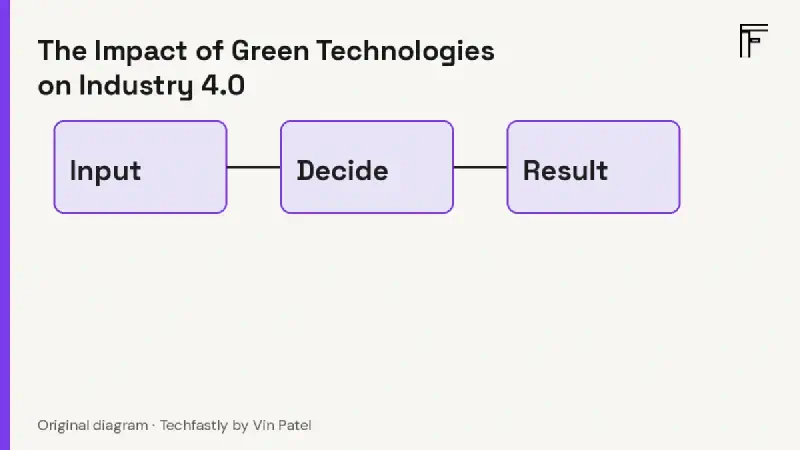
Original diagram for Techfastly by Vin Patel.
Organizational and technical sustainability is a sort of internal sustainability that focuses on a company’s internal operations. It is concerned with the most efficient utilization of resources. It entails the employment of human labor, the upkeep of technical equipment and machinery, and IT infrastructure implementation.
Sustainable manufacturing refers to the long-term viability of manufacturing processes in the manufacture of environmentally friendly products in compliance with the conditions imposed by environmental protection and cost-cutting demands.
Sustainable supply chain and logistics refer to the long-term viability of supply chains and logistics networks based on the need for continuous supply security and waste management. The key to managing and optimizing supplier networks is a collaboration between businesses involved in distribution, warehousing, transportation, and other logistics services. In the field of logistics, it’s all about long-term sustainability as a result of transportation’s negative environmental impact.
The Triple Bottom Line is a fundamental notion of sustainability based on the 3P model (People, Planet and Profit). Meeting human needs and achieving a satisfactory quality of life while efficiently allocating resources (economically), conserving natural resources, including ecosystems and biodiversity (ecologically), and making social resources accessible to all while preserving cultural diversity (socially) are all part of the triple bottom line (socially).
Circular Economy (circularity) is an economic strategy that aims to reduce waste by allowing unrestricted resource utilization. The SGI 4.0 framework unifies the utilization of technology and resources through environmentally friendly processes, ensuring long-term viability.
Sustainability outcomes are characterized by the most commonly found advantages for each category and are separated into three groups (economic, environmental, and social).
End Note #
New research based on our SGI 4.0 paradigm should attempt to demonstrate empirical results of green process sustainability outcomes in relation to Industry 4.0. In the context of Industry 4.0, the SGI 4.0 framework enables the development of assessment tools for evaluating the sustainability of green processes. The framework identifies which sustainability outcomes should be considered when developing these techniques. This research creates a framework for companies using Industry 4.0 technology to adopt and facilitate sustainability through green operations. It provides a conceptual and theoretical framework for empirically testing the link between these variables.
According to reports, our world will change dramatically in 2024, with solar becoming 35% cheaper, wind energy capacity increasing by 57%, hydroelectric capacity increasing by 9%, and geothermal capacity increasing by 28%. This is demonstrated by the fact that India is the world’s second-largest renewable energy generator, trailing only China and the United States.
Green technology is unavoidably the way of the future. Many investors have been focusing on start-ups that create a sense of security in reaction to the anticipation and worry surrounding climate change and a growing scarcity of natural resources. As a result, a significant number of firms have begun to revolve around the new trend of embracing green technology. Another reason corporations are focused on green technology is because a clean and safe future must support environmental goals and sustainable practices using the newest technical breakthroughs.
Related reading