

Going Green with The Internet of Things (IoT)
"Kevin Ashton coined the term "Internet of Things" during a 1998 presentation in which he said, "The Internet of Things can revolutionize the world, just.
Updated
On this page
Key takeaways
- “Kevin Ashton coined the term “Internet of Things” during a 1998 presentation in which he said, “The Internet of Things can revolutionize the world, just as the Internet did.” Maybe even more”.
- Green Cloud Computing is an exercise in implementing policies and procedures to reduce the power consumption of data centers (i.e.
- Companies are already successfully using embedded technology and IoT applications to develop engineering innovations that benefit both the environment and the business.
“Kevin Ashton coined the term “Internet of Things” during a 1998 presentation in which he said, “The Internet of Things can revolutionize the world, just as the Internet did.” Maybe even more”.
There is a growing awareness in businesses that they are going green – there are significant side effects from reducing the company’s carbon footprint, conserving resources, and protecting the environment. This is also good business.
Environmental issues affect many plants, but with the rapid spread of the Internet of Things (IoT), efficient, economical, and sustainable solutions are available. Innovative embedded IoT products benefit the environment while addressing some of these business challenges. It concludes by looking at IoT’s exciting capabilities to provide economically and environmentally conscious solutions.
What is Green IoT? #
#
Green Internet of Things (IoT) represents the concept of reducing IoT devices consumption and making the environment safer. It has been described in IoT as an energy-efficient way to either reduce the greenhouse effect caused by existing applications or eliminate it in IoT itself.
In general, the Green IoT is a low-power version of the IoT and is seen as the future of the IoT, which is “environmentally friendly.”
The total installed base of IoT-connected devices worldwide is estimated at 30.7 billion by 2020. In addition, this amount will increase to 75.4 billion devices by 2025.
- By 2021, there will be more than 10 billion active IoT devices.
- It is estimated that by 2030, the number of active IoT devices will exceed 25.4 billion.
- 83% of organizations have improved their performance by introducing IoT technology.
Enabling Technology For Green IoT #
The deployment of IoT in the real world is possible only with the help of many technologies. Here, we discuss highly relevant technologies and focus on the green aspects that strengthen the green IoT era.
Green RFID Tags #
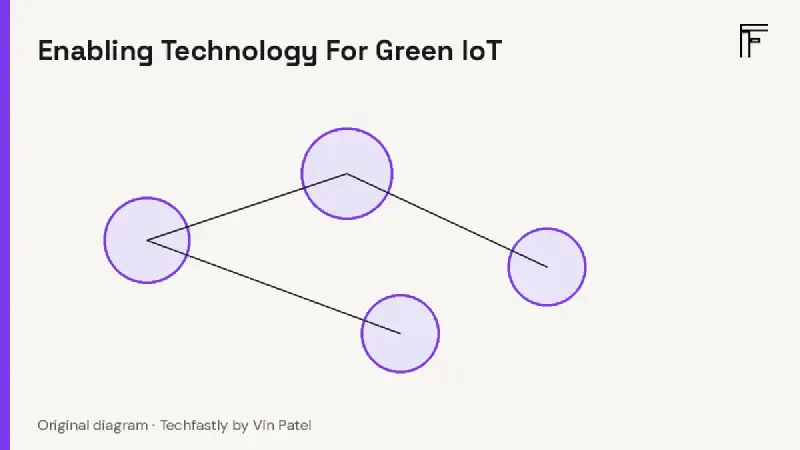
“Communication anytime, anywhere “has long been a dream and driven by advances in wireless communication technologies. Today, the ratio between radio and humans is almost one to one. Size, energy consumption, and cost-reduction radio lead to its integration into almost every object. One of the most promising wireless systems to enable IoT is RFID. RFID is used for which they are connected. There are two types of RFID.
Original diagram for Techfastly by Vin Patel.
- Active Tags: They have built-in batteries that constantly transmit their signals.
- Passive Tags: They store energy from the reader. Green RFID tags represent the concept of reducing the size of RFID tags. Thus reducing the amount of non-degradable material
Green Sensing Networks (WSNs) #
The fusion of sensing and wireless communication has led to the emergence of wireless sensor networks (WSNs) and represents a key enabling technology that helps IoT flourish. Recently, WSNs have been proposed for a variety of applications, such as fire detection, object tracking, and environmental monitoring. Accordingly, the commercial use of WSNs is expected to increase dramatically soon. This includes storing capacity requirements as well as implementing smart data algorithms to reduce data size.
Green Cloud Computing
The rapid expansion of data centers, the rapid development of cloud computing have led to a dramatic increase in energy consumption and the impact on the environment in terms of carbon footprints.
Green Cloud Computing is an exercise in implementing policies and procedures to reduce the power consumption of data centers (i.e. alerting them to energy and shutting down inactive devices in the network and routing their packets.)
Green M2M
Since a large number of machines involve machine-to-machine or M2M communication, there should be energy-saving routing algorithms and transmission power and optimized communication protocols. In addition, passive nodes should be constantly monitored to save energy.
Green IoT and Beyond with 5G #
In recent years, information technology trends such as cloud computing and Edge Cloud, artificial intelligence, and security assurance have accelerated the IoT ecosystem.
Similarly, implementing Green IoT with 5G adds additional barriers to the efficient transfer of huge data.
Green IoT aims to create a smarter, greener world, and energy harvesting forms the basis of a green, 5G-powered IoT ecosystem. This special issue aims to combine cutting-edge research into these key areas of green IoT systems capable of 5G for a smart future.
IoT is about collecting and using data, because IoT-based systems are becoming ubiquitous, meaning ever-increasing amounts of data. The International Data Corporation estimates that by 2020, 44 zettabytes will be collected, transmitted, analyzed, and implemented.
Few people think of internet companies as having resources for manufacturing. But with all this data, the biggest Internet companies run massive data centers that use a lot of energy.
#
How IoT is Helping the Earth #
Today, the majority of IoT application development companies develop applications to collect and analyze data using data science. What if these applications could be used more than that?
Here are some ways in which the concept of Green IoT can be used to benefit environmental protection and surveillance:
#
Green Driving #
The IoT can be used to understand and operate the automobile on the road and what other vehicles are going to do. This is nothing but green driving. This enables traffic to move at a certain speed with minimal distance between vehicles, thus minimizing fuel shortages caused by regular changes in vehicle gears.
For example, IBM’s Watson is used to make a car without a driver named Ollie - Watson analyzes large amounts of data that emanate from in-car sensors and based on the analysis it is fast, slow, and lane changes (everything without a driver).
#
Smart Farming #
Farmers can use IoT capabilities by installing sensors wherever they are needed such as in the field, in tools and equipment, in vehicles and tractors, etc, to collect data on aspects such as soil moisture and its health.
The collected data can be stored on a server/cloud, which farmers can later get in real-time. It offers farmers a smart, data-driven approach to improving their yields and reducing waste.
Reduce Air Pollution #
IoT can help reduce air pollution by using real-time air quality monitoring it can spread small, mobile-powered sensors across a variety of locations and areas, from means of transportation to stationery. Air quality can be achieved by providing a broader picture of the surface.
Furthermore, this real-time information can be estimated to expose the onset and fluctuations of air pollution. It can be communicated to people through apes, which give them an update on the level of pollution they are living with.
Reduce CO2 Emissions #
IoT can help reduce carbon dioxide (CO2) emissions from automobiles through smart traffic management. Here, the purpose is to extract data from various sources such as traffic cameras, GPS/Sensors of vehicles, etc., and use it to examine and understand the traffic conditions and patterns.
Conclusion #
Protecting the environment is a big part of the business - not only because citizens and legislators demand it, but also because it’s good for the economy. While business challenges will continue to grow and evolve, technologies are emerging and changing to make it easier for businesses to meet these challenges and thrive.
Companies are already successfully using embedded technology and IoT applications to develop engineering innovations that benefit both the environment and the business.
Related reading