

Does Quantum Cryptography Caber Security?
Well, cryptography answers it all.*** The system that has secured our web activity and interactions for years is on the verge of being wiped out. Businesses.
Updated
On this page
Key takeaways
- Businesses and organizations should be aware of this today and prepare for cryptography in the quantum era.
- The method of storing and processing data using hash tables is known as hashing.
- — [R1]Replace Alice with Mark and Bob with Jacob.
Have you ever wondered if the payments, contacts, and data transfers that take place over the internet are secure? Is it possible to hack them? How is all this data protected? Well, cryptography answers it all.
The system that has secured our web activity and interactions for years is on the verge of being wiped out. Businesses and organizations should be aware of this today and prepare for cryptography in the quantum era.
Before we go further, let us understand Quantum Cryptography.
What is Quantum Cryptography? #
Cryptography is the technique of encrypting data or altering plain text so that only those with the correct “key” can access it. By application, quantum cryptography encrypts data and sends it in an extremely secure manner using quantum mechanics techniques. The basic principles of quantum mechanics behind quantum cryptography are:
- The particles that form the universe are unpredictable, and they can exist in multiple states simultaneously.
- Photons are generated in one of the two quantum states at random.
- It is impossible to measure a quantum feature without allowing it to change.
- It is possible to clone some properties of the quantum particle but not the entire particle.
Cryptographic techniques that are expected to be safe against a quantum computer hack are known as post-quantum cryptography. It is based on difficult mathematical equations. Traditional computer systems take months, if not years, to solve these complicated mathematical calculations. Quantum computers executing Show’s algorithm, on the other hand, will be able to crack logic systems in a matter of seconds. Quantum cryptography, on the other hand, employs quantum mechanics to convey private messages and is fully secure, unlike mathematical encrypt. Quantum key distribution makes use of these quantum mechanical features to generate and distribute a shared key while ensuring that no third parties have intruded.
How Does Quantum Encryption Work? #
Quantum cryptography or quantum key distribution (QKD) uses a series of photon or light particles to transmit data over a fire optic from one location to another. It’s a method of spreading and distributing the secret keys required by data encryption. In addition, the method must ensure that they remain secret between the sender and receiver. Information is often stored on single photons, and after both sides’ keys have been safely generated, their interactions are secure. Quantum communication systems are expected to offer virtually unbreakable encryption.
Let’s understand the process of this encryption model:
Step 1: The sender transmits photons through a polarizer or filter, which randomly allots them bit designations and polarization. The four possible polarizations and bit designations are Horizontal (Zero bit), Vertical (One bit), 45 degrees left (Zero bit), or 45 degrees right (One bit).
Step 2: The receiver needs to use two beam splitters (horizontal/vertical and diagonal) to “read” the polarization of each photon.
Step 3: After sending the photons, the receiver must inform the sender of the beam splitter used for each photon of the stream. The sender compares the sequence before sending the key. If the photons are read with the wrong beam splitter, they are discarded, and the resulting sequence of bits becomes the key. If the photon is read or copied in by any eavesdropper, the photon’s state will change, which will be detected by the endpoints.
Example of how quantum encryption works: #
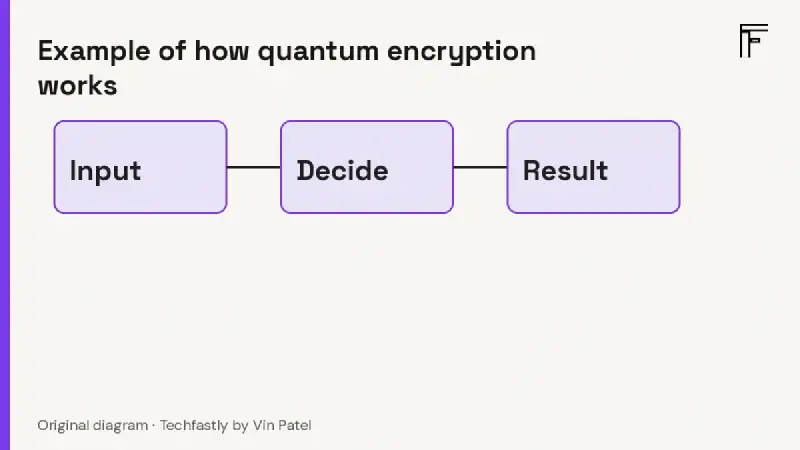
Original diagram for Techfastly by Vin Patel.
The standard techniques for encryptions are:
Symmetric Encryption– In this type of encryption, only one key is used to both encrypt and decrypt the data. Using symmetric encryption algorithms, data is converted to a form that can be understood only by someone who possess the secret key to decrypt it. The algorithm reverses its action, and the message is returned to its original and
understandable form once it reaches the intended recipient who possesses the key. The secret key that the sender and recipient both use could be a specific password/code or a random string of letters or numbers generated by a secure random number generator (RNG).
**Asymmetric Encryption-**This encryption technique encrypts and decrypts the data using two separate cryptographic keys: a ‘Public Key’ and a ‘Private Key.’ The most exciting feature of this new strategy is that while a public key can be used to encrypt text, it cannot be used to decrypt it. The text will not be decrypted by any other user’s private or public keys. The data flow is extremely safe using this technology.
**Hashing-**It is the process of using a mathematical function to turn input of any length into a fixed-size text string. The method of storing and processing data using hash tables is known as hashing. Hashing is also used in data encryption. Passwords can be stored in the form of their hashes. In case there is a breach in database, plaintext passwords will not be accessible.
Show’s Algorithm in Quantum Computing #
Peter Show, in 1994, created Show’s algorithm for integer factorization on quantum computers. The procedure identifies the prime factors of a positive integer P. Show’s algorithm runs in polynomial time, which is polynomial in log N order.
The algorithm is important because it means that, with a sufficiently big quantum computer, public-key cryptography may be easily destroyed. The public key N in RSA, for example, is the product of two large prime numbers. Factoring N is one approach to defeat RSA encryption, however, factoring gets increasingly time-consuming as N goes larger; more particular, no classical algorithm exists that can factor in time O((log N)k) for any k.
Show’s algorithm, on the other hand, can break RSA in polynomial time. It also gets into a variety of different public-key cryptosystems.
Show’s technique is predictable like all quantum algorithms; it provides the correct answer with a high probability. But, finding a practical quantum crypt algorithms security solution may take some time. There are already two decent options, and studies have been continuing for quite some time. The first method is known as post-quantum cryptography, and it is based on different mathematical equations than those presently in use. The second method makes use of quantum physics to find new cryptographic answers.
Why Don’t We Utilize Quantum Cryptography? #
If quantum cryptography is so safe, why don’t we just use it?
Quantum cryptography involves the use of specialized hardware. To make it work, you’ll need photon detectors, beam splitters, and other components. As a result, we won’t be able to fit it into a small device like your phone.
Even though quantum encryption is secure, it doesn’t mean it is shielded from all threats. Side-channel cyberattacks are a possibility. These occur as a result of a flaw in the cryptosystem’s design rather than a flaw in the algorithm itself. Although no one has effectively received photons during the creation of the key in quantum key distribution protocols; side-channel threats do occur in quantum cryptography.
Will Caber Security be Ensured? #
Even though data transfer over the internet is now assumed to be secure, it is still prone to hacking through which malicious people steal and copy encrypted messages to decipher them. For data with a long-term risk, companies may wish to add an extra level of security.
Quantum cryptography, however, not only generates the threat but also offers a remedy. When sharing the encryption key through a method known as quantum key distribution (QKD), quantum-based technologies can be used to identify the presence of hackers on a link. When combined with the one-time-pad cypher, the protocol provides unbeatable encryption security.
It is mainly aimed at those who want to protect their secret links for extended periods and with the highest amount of safety, such as public organizations and military people.
Conclusion #
The necessity for quantum cryptography is right in front of our eyes. The safety of encrypted data is now in danger, with the advancement of quantum computers. Thankfully, Quantum Cryptography provides the solution we need to protect our data for the near future - all based on the rules of quantum physics.
Quantum Cryptography is the answer that will protect confidential matters as the need for encryption technology grows in networks that are connected.
[R1]Replace Alice with Mark and Bob with Jacob
Related reading