

A Brief Overview to Quantum Algorithms
Quantum computing is the solution to the enormous performance boost of our innovation. A Quantum is the latest buzzword in Physics that most people talk about.
Updated
On this page
Key takeaways
- Quantum computing is the solution to the enormous performance boost of our innovation.
- !Diagram: Quantum Circuit Concept Original diagram for Techfastly by Vin Patel. Quantum circuits are a collection of quantum gates that express quantum wires that intertwine the quantum algorithms.
- But it won’t be long before we build that bridge and cross it!
Quantum computing is the solution to the enormous performance boost of our innovation. A
Quantum is the latest buzzword in Physics that most people talk about, but only a few understand. Almost every electronic device in use illustrates quantum theory in play with the extensive application of transistors and lasers.
Quantum computers process data 100 million times quickr than traditional computers, making them highly advantageous. Although major quantum parts exist in theory, giant corporations like IBM, Microsoft, and Google rush to develop quantum tools.
Introduction to the Quantum Theory #
Quantum theory is the foundation of modern physics that explains everything around us at an atomic and sub-atomic level. The amalgam of quantum theory with mathematics and computers is quantum computing.
Quantum computers are machines that implement quantum computing. They process and store information, and their exceptional design makes them handle complex problems swiftly.
These devices operate through a quantum bit, also known as a quit. Unlike the classical bit, they exist in the states of 1s and 0s simultaneously.
Now that we have learned the required fundamentals, let’s plunge into the central subject of Quantum Algorithms.
What are Quantum Algorithms? #
Original diagram for Techfastly by Vin Patel.
Quantum algorithms are operations that we can only perform in practical quantum computers. They are either a set of instructions or procedures that help solve problems or perform calculations.
These algorithms either use entanglement or superposition, making them faster and more effective than classical algorithms.
Superposition #
A quantum system’s property exists in multiple states simultaneously, like a coin in the air.
Entanglement #
This property involves combining and intertwining quantum objects permanently.
Why use Quantum Algorithms? #
Quantum algorithms have wide usage and can solve impossible problems.
- Model chemical and physical interactions.
- Cryptography
- Search and optimization
- Simulation of Quantum systems
- Amplification of amplitude
- Solving the parity problem
- Few-quit applications and experimentation
- Zero-quit applications
- Resolving large systems of linear equations
The Major Differences between Classical and Quantum Algorithms #
Besides faster computation and tackling the most complex problems:
You can apply a quantum algorithm to a quantum computer only. On the other hand, you can employ a classical algorithm in both traditional and quantum computers.
The quantum algorithm uses quits for computation, while a classical one only uses bits.
A quantum algorithm is reversible, consisting of both forward traversals and reverse traversals. Nothing much exists in a classical algorithm.
Quantum Circuits #
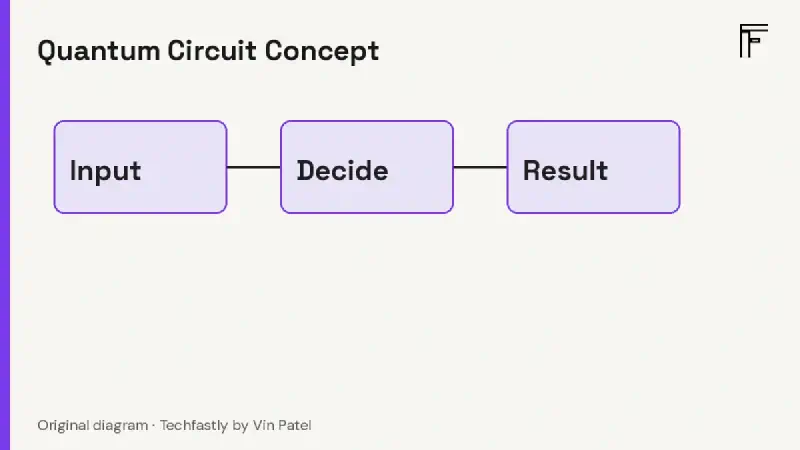
Original diagram for Techfastly by Vin Patel.
Quantum circuits are a collection of quantum gates that express quantum wires that intertwine the quantum algorithms. They use one or more quits in computation.
Types of Quantum Algorithms #
Based on different types of quantum circuits, we’ll divide quantum algorithms into two broad categories:
Algorithms based on the Quantum Fourier Transform #
The Quantum Fourier Transform implements the discrete Fourier Transform with an exponential speedup. It is one of the most critical processes in quantum computing and constitutes several major quantum algorithms.
They include the famous Show’s Algorithm, Simone’s Algorithm, The Bernstein-Vazirani Algorithm, and Deutsch-Jozsa Algorithm.
Show’s Algorithm #
Show’s algorithm investigates factoring integers in polynomial time and solving the discrete logarithm problem.
It’s one of the quantum algorithms that solve non-black-box problems on polynomial time. Also, these problems aren’t P or NP-complete.
Applications of Show’s Algorithm include:
Cryptography
Quantum Factoring and Finding Hidden Structures.
Simone’s Algorithm #
Simone’s Algorithm was the first quantum algorithm to show an exponential speedup that outdid the best of classical algorithms.
It solves a black-box problem quicker than any other classical algorithm.
Deutsch-Jozsa Algorithm #
Deutsch-Jozsa Algorithm is the first quantum algorithm that outperformed the classical algorithm. It solves the black-box problem using a single query only.
The Deutsch-Jozsa algorithm is a deterministic quantum algorithm proposed by David Deutsch and Richard Jozsa in 1992 with improvements by Richard Clever, Arthur Exert, Chiara Macchiavello, and Michele Musca in 1998.
Bernstein-Vazirani Algorithm #
The Bernstein-Vazirani Algorithm is a restriction of the Deutsch-Jozsa algorithm. It shows the advantages of using a quantum computer as a computational tool for more complex problems than the Deutsch-Jozsa problem.
It was intended to create an oracle separation between the black boxes BQP and BPP and takes a different approach to functions by learning a string embedded in a function.
This theory was put out by Ethan Bernstein and Mesh Vazirani in 1992.
Algorithms based on Amplitude Amplification #
The Amplitude amplification is a procedure allowing the amplification of the desired subset of quantum space. It simplifies the theory behind Grover’s Algorithm, creating a whole series of quantum algorithms.
Grover’s Algorithm #
Grover’s algorithm demonstrates the ability of quantum computers to compute a million times faster than a classical computer. The main operation of this algorithm is to do quick searches through an unsorted database.
This theory was given in 1996 by Lov Grover.
Applications of Grover’s Algorithm:
It helps find the minimum in an unstructured list of ‘N’ number of integers.
It has uses in pattern matching and bioinformatics.
In optimization and search
It also helps determine the graph’s connectivity
The Future of Quantum Algorithms #
Original diagram for Techfastly by Vin Patel.
But without being able to simulate their performance on comprehensive
problems or analyze them, it’s unlikely to predict how they’ll work in the practical world.
The Architects of the Quantum algorithm developed several models, but only some have successfully interpreted their performance.
A vast leap still needs to be filled to bridge the gap between theoretical and computational. But it won’t be long before we build that bridge and cross it!
Related reading
- An Overview of How API Architectures have Evolved
- Keywords in Python: A Brief Introduction
- 10 Best JavaScript Super Cool Features
Questions and answers
What are Quantum Algorithms? #
Quantum Algorithm Quantum algorithms are operations that we can only perform in practical quantum computers. They are either a set of instructions or procedures that help solve problems or perform calculations.
Why use Quantum Algorithms? #
Quantum algorithms have wide usage and can solve impossible problems. - Model chemical and physical interactions.