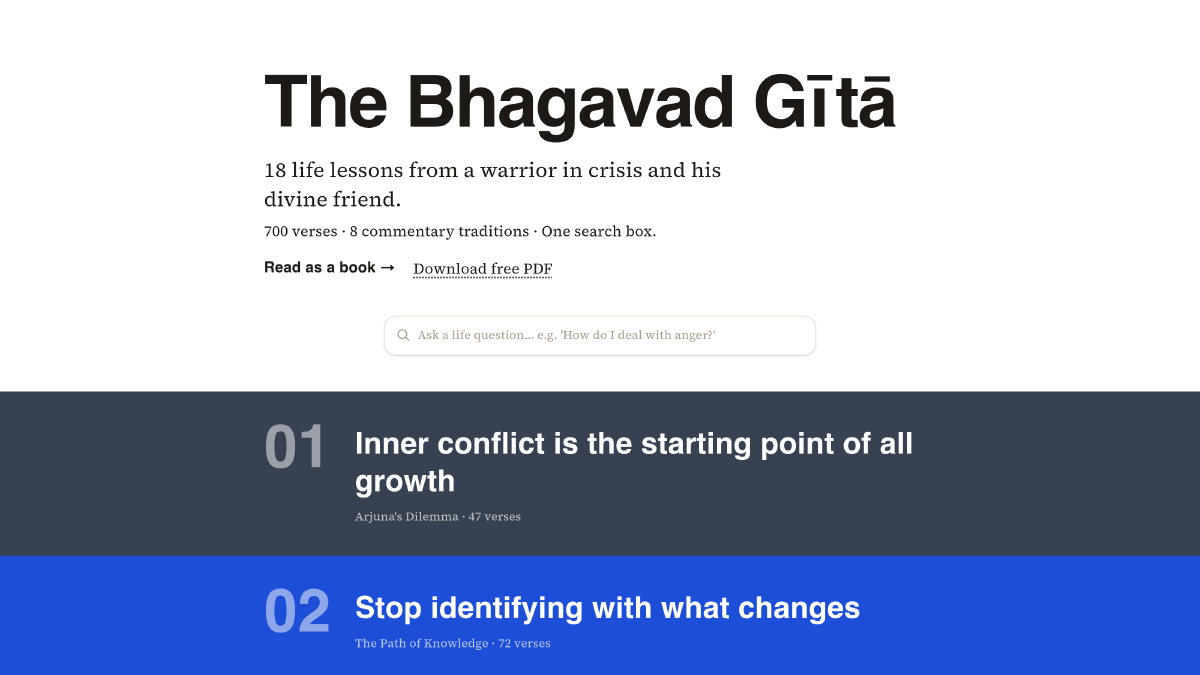
Visit bhagavad.net → | View on GitHub →
Most Gita apps give you a translation. Maybe two.
They don’t answer the question every modern reader is actually asking: “How does this verse apply to MY life, right now?”
And they never show you what 1,200 years of Indian philosophical debate looks like — eight distinct traditions reading the same verse and arriving at completely different conclusions.
This project fixes that.
What It Is
A verse-by-verse Bhagavad Gītā app where every one of the 700 shlokas becomes:
- A multi-tradition conversation — 8 philosophical voices commenting on the same verse
- Actionable life wisdom across 4 pillars: Personal Growth, Career, Health, Relationships
- Real questions people actually ask — conversational, not academic — mapped to the verses that answer them
The bigger vision: a replicable template for making all ancient Indian literature accessible — the Upanishads, Yoga Sutras, Dhammapada, Thirukkural, and beyond.
The Core Problem With Existing Gita Apps
Take verse 2.47 — “Your right is to action alone, never to its fruits.” Possibly the most quoted verse in the Gita.
Here’s what five traditions do with it:
- Shankaracharya reads it as a teaching about the unreality of action itself — the Self is the witness, never the actor
- Ramanujacharya reads it as God-dedicated action — act as service to the Lord, who is the true enjoyer of results
- Madhvacharya insists on the real distinction between God and soul — you act, but God alone determines outcomes
- Tilak reads it as a manifesto for selfless social action — the verse that inspired India’s independence movement
- Vivekananda reads it as a call to fearless strength — weakness is the only sin
Same verse. Five completely different life philosophies. Most apps give you one. This app gives you all eight.
The 5-Layer Content Pipeline
Every verse passes through five layers of transformation:
Layer 1 — Source Text Sanskrit in Devanagari + IAST transliteration. Public domain. Standardized 700-verse numbering. Unchanged for 2,000+ years.
Layer 2 — Multi-Tradition Interpretation Eight philosophical voices comment on each verse, spanning classical (pre-1600, public domain) and modern traditions:
| Tradition | Teacher | What They See |
|---|---|---|
| Advaita | Shankaracharya (~8th c.) | The Self is Brahman. Liberation is recognizing what you already are. |
| Vishishtadvaita | Ramanujacharya (~11th c.) | The soul is a part of God. Liberation is eternal service to the Lord. |
| Dvaita | Madhvacharya (~13th c.) | God, souls, and matter are eternally distinct. Devotion through understanding. |
| Bhakti | Traditional | Love is the way. Surrender and devotion transcend intellectual knowledge. |
| Kashmir Shaivism | Abhinavagupta (~10th c.) | Consciousness (Spanda) is the foundation. Liberation is recognition. |
| Shuddhadvaita | Vallabhacharya (~16th c.) | The world is real and divine. God’s grace (puṣṭi) is the path. |
| Karma Yoga | Tilak / Gandhi (~1915) | A call to selfless action. Duty, social responsibility, engaged ethics. |
| Practical Vedanta | Vivekananda (~1896) | Strength is spirituality. Serve humanity as worship. |
Layer 3 — Synthesis An original multi-tradition synthesis (200–300 words) per verse — not a summary, but a conversation. What do all eight traditions agree on? Where do they diverge, and why? What’s the universal teaching underneath?
Layer 4 — Life Application Four pillars of practical guidance per verse: Personal Growth, Career & Business, Health, and Relationships. Plus four real life questions per pillar — the actual questions people search for — mapped to the verse that answers them.
Layer 5 — Validation Schema-enforced accuracy at build time. Sanskrit fields must contain Devanagari Unicode. IAST fields must contain proper diacritical marks. Build fails on invalid data. No silent errors.
How the Content Was Generated
The scale problem: 700 verses × 15 structured fields each = a content generation challenge that required rethinking the approach entirely.
Phase 1 — 18 Parallel Agents One AI agent per chapter, all running simultaneously. Each agent received the exact Zod schema, a reference verse showing expected quality, chapter-specific narrative context, and strict copyright rules. Initial generation produced 3 traditions per verse.
Phase 2 — Gap Filling Longer chapters hit context limits. Targeted agents handled specific verse ranges, producing part files that were merged using a Python script: deduplicate by verse number, sort, write back as clean JSON.
Phase 3 — Multi-Tradition Enrichment Six parallel agents expanded every verse from 3 traditions to 8, simultaneously rewriting each synthesis paragraph to weave all traditions together.
Why this architecture works: No conflicts (each agent writes to a different file), consistent quality (same schema and examples across all agents), incremental (part files can be reviewed independently), and auto-loading (the content config reads all chapter-*.json files automatically).
The Data Architecture
Every verse is a structured JSON object:
{
  "id": "BG-2.47",
  "chapter": 2,
  "verse": 47,
  "sanskrit": "Devanagari text",
  "iast": "IAST transliteration",
  "explanation": "Accessible 2–3 sentence explanation",
  "synthesis": "Multi-tradition synthesis (200–300 words)",
  "commentaries": [
    {
      "tradition": "advaita",
      "teacher": "Adi Shankaracharya",
      "text": "Tradition-specific interpretation"
    }
  ],
  "applications": {
    "personal_growth": "Practical guidance paragraph",
    "career_business": "Practical guidance paragraph",
    "health": "Practical guidance paragraph",
    "relationships": "Practical guidance paragraph"
  },
  "questions": {
    "personal_growth": ["4 real life questions this verse answers"],
    "career_business": ["4 real life questions"]
  },
  "themes": ["searchable", "modern", "tags"]
}
Tech Stack
- Framework: Astro 5 (static site generation — every page is pre-built HTML)
- Styling: Tailwind CSS v4
- Interactive Islands: Preact (commentary tabs, application tabs)
- Validation: Zod schema, enforced at build time
- Fonts: Cormorant Garamond, Source Serif 4, Tiro Devanagari Sanskrit
- Hosting: GitHub Pages — bhagavad.net
By the Numbers
| Metric | Count |
|---|---|
| Verses | 700 across 18 chapters |
| Philosophical traditions | 8 (spanning 1,200 years) |
| Unique tradition commentaries | 5,600+ |
| Life application paragraphs | 2,800 |
| Life questions mapped to wisdom | 5,600+ |
| Parallel AI agents used | 18 (generation) + 6 (enrichment) |
| Copyrighted content reproduced | 0 |
Legal Framework
Classical commentaries (pre-1600) are public domain. Sanskrit source text is public domain (Delhi High Court, 2024). Modern interpreters — Tilak, Vivekananda — are paraphrased and synthesized only, never reproduced. No content from BBT/ISKCON, Chinmaya Mission, or Sri Aurobindo Ashram. All synthesis, life applications, life questions, and theme mappings are original work.
What’s Next
- Search by life question — “I’m struggling with anger at work” finds the exact verses that speak to it
- Sanskrit learning — a 14-day curriculum wired to actual Gita verses
- Mobile — PWA or React Native
- More texts — Upanishads, Yoga Sutras, Dhammapada, Thirukkural — same pipeline, different traditions
The schema is the contract. The traditions and pillars are pluggable. The architecture scales linearly to any ancient text.