
In 1997 I built a website called 123ofnet.com. In 2001 I built a second one, 123ofcomputers.com, as a category-based portal for techies. Both ran for years. Then I let them go.
I rediscovered the screenshots last week. Sitting with them for an hour, I realized they’re not just nostalgia — they’re a snapshot of the model of the web that used to exist, the one that died quietly when Google’s PageRank made it obsolete, and the one that — for very specific reasons — is now being reborn for AI agents.
This essay is what I saw when I looked at those two screenshots.
1997: 123ofnet.com — “An Easy Soltuion To The NET”
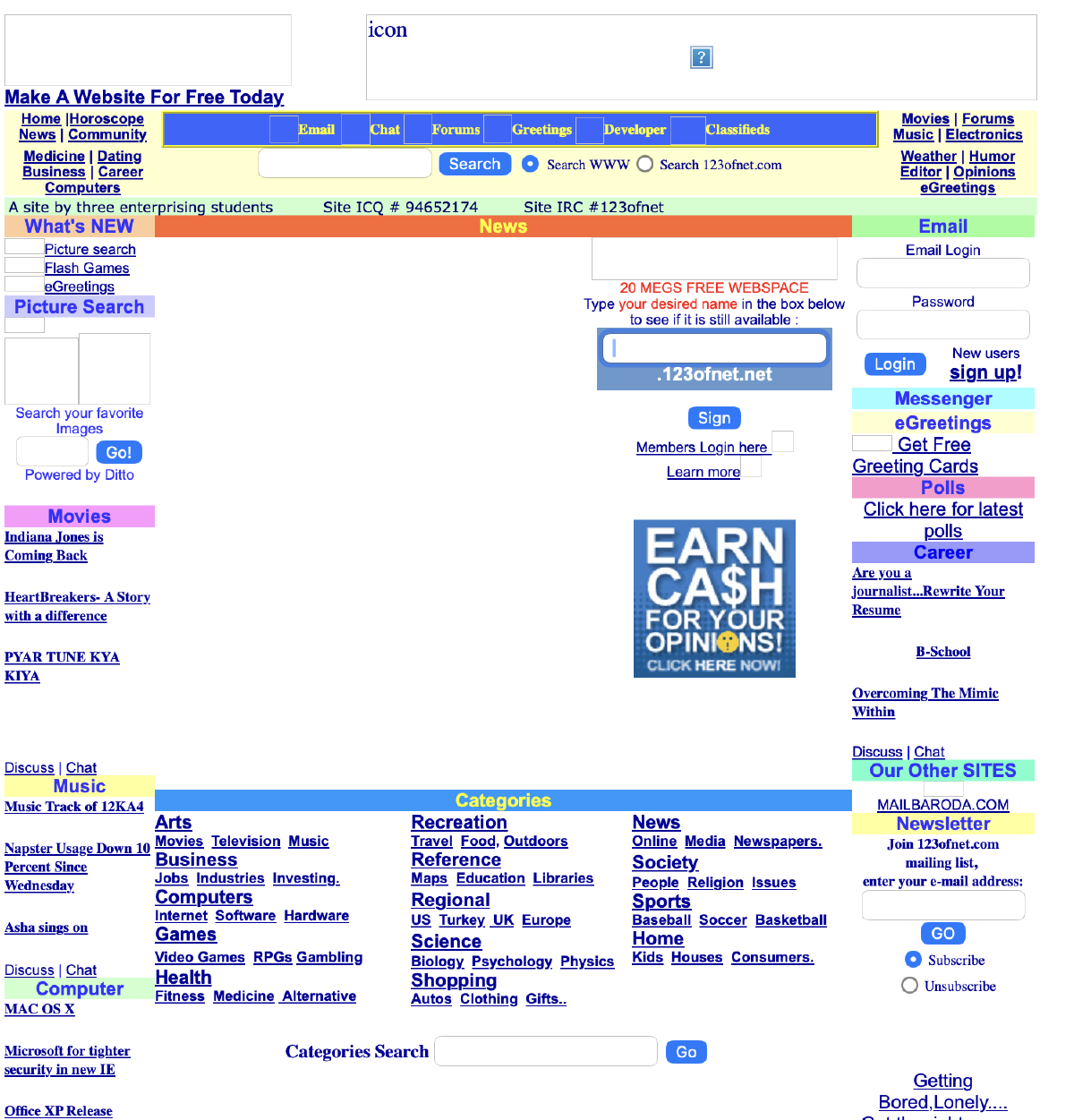
The earliest snapshot the Internet Archive holds of 123ofnet.com is from October 18, 2000 — three years after I launched it. The Wayback Machine didn’t crawl small Indian sites consistently in the 90s, so the version I built first is lost to public history. But the 2000 capture preserves the tagline I wrote, typo and all:
“123ofnet.com — An Easy Soltuion To The NET !!!”
The HTML source of that snapshot tells you everything you need to know about the era:
<meta name="GENERATOR" content="Microsoft FrontPage 4.0">
<meta http-equiv="Content-Type" content="text/html; charset=windows-1252">
I built it in Microsoft FrontPage 4.0 — which was, at the time, the most professional consumer-grade web-authoring tool you could touch. No CSS frameworks. No JavaScript runtimes. No npm install. No deployment pipeline. You opened FrontPage, you laid out tables, you saved, you opened an FTP client, you dragged the file onto a remote server, you reloaded the browser. That was the loop.
The hosting was a free service called HyperMart — that detail is preserved in a comment block in the archived HTML: “This site is hosted for FREE on HyperMart — yours can be, too!” HyperMart was the Vercel of 1997: free static hosting in exchange for a banner ad that ran on every page you served. The economics were the same; the polish was different.
Where it actually started: a basement in Baroda
123ofnet.com didn’t start in an office or a dorm. It started in the basement of my friend Jay Patel’s house, built by a crew of us who were all still students. The homepage modestly billed itself as “a site by three enterprising students” — but the real team that built and ran it was bigger:
- Jay Patel — whose basement became our first office
- Vin Patel — myself
- Vishal Varma
- DebuJyoti Ray
- Malay Gandhi and Manuni Gandhi
- Nirav Patel
Most of the work happened after class, on borrowed machines and a shared dial-up line. No funding, no mentors, no framework. Just a group of friends who wanted to build the whole internet on one homepage.
And here’s the homepage we actually shipped:
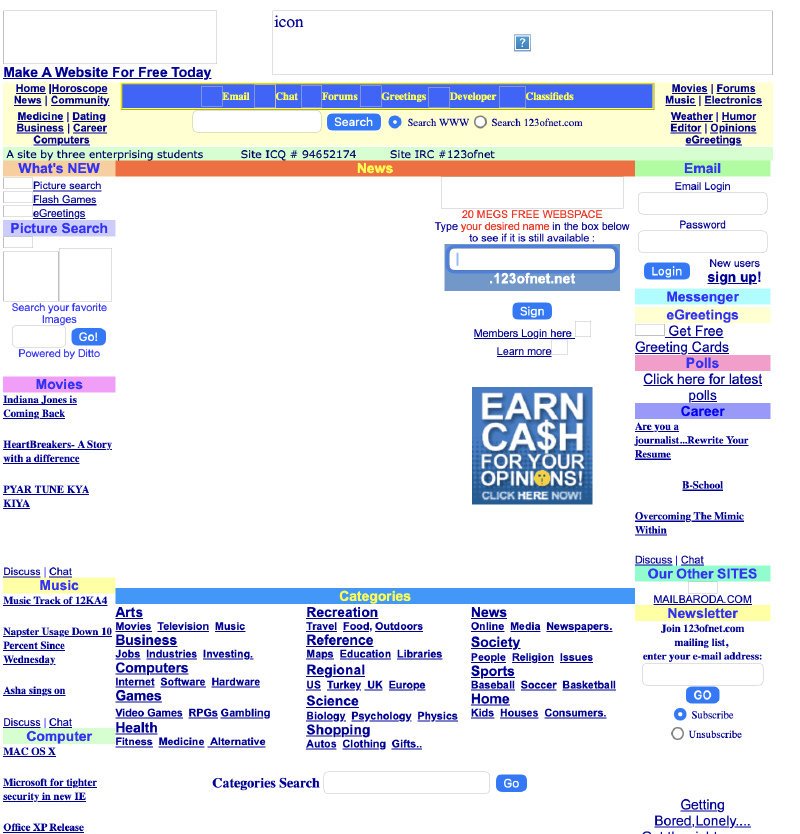
Now look at what we built into that one page. Every item below is a distinct capability we stood up — years before most of them became their own product categories:
- Free webmail — full email accounts with login and password, and a “New users sign up!” flow. We were running a mail service.
- Free web hosting — “20 MEGS FREE WEBSPACE,” with personalized
.123ofnet.netsubdomains and a live name-availability checker. “Make A Website For Free Today.” This was Geocities-tier generosity from a student project. - Chat, Forums & Messenger — real-time chat, message boards, and an instant-messenger rail. Community infrastructure, self-hosted.
- Picture Search — an image-search engine, “Powered by Ditto” — visual search years before it was mainstream.
- eGreetings — free greeting cards, our own greeting-card platform.
- Flash Games — casual games, embedded and free to play.
- Developer & Classifieds — a developer section and a classifieds marketplace, right in the top nav.
- A Yahoo-style directory — hand-categorized topics across Arts, Business, Computers, Games, Health, Recreation, Reference, Regional, Science, Shopping, Society, Sports, News, and Home, each with sub-categories. Human-curated navigation for the whole web.
- News aggregation — a rolling feed across Movies, Music, and Computing (Napster, Mac OS X, IE security, Office XP). We were curating the day’s headlines by hand.
- Polls, Horoscopes, Career, Weather, Humor, Opinions, Newsletter — a wall of lifestyle and utility verticals, plus a mailing list with subscribe/unsubscribe.
- Dual-scope search — one search box, two modes: Search WWW or Search 123ofnet.com.
- Community rails — a live presence on the platforms of the era: ICQ #94652174 and IRC #123ofnet.
Read that list again. Webmail, hosting, chat, search, e-greetings, classifieds, a directory, news, community — a group of students built a full web portal, the Yahoo / Rediff playbook, out of a basement, mostly as teenagers. The tagline undersold it: this was a lot more than “three enterprising students.”
Here’s what 123ofnet.com had grown into by the time I rebuilt it as a network homepage, around 2002:
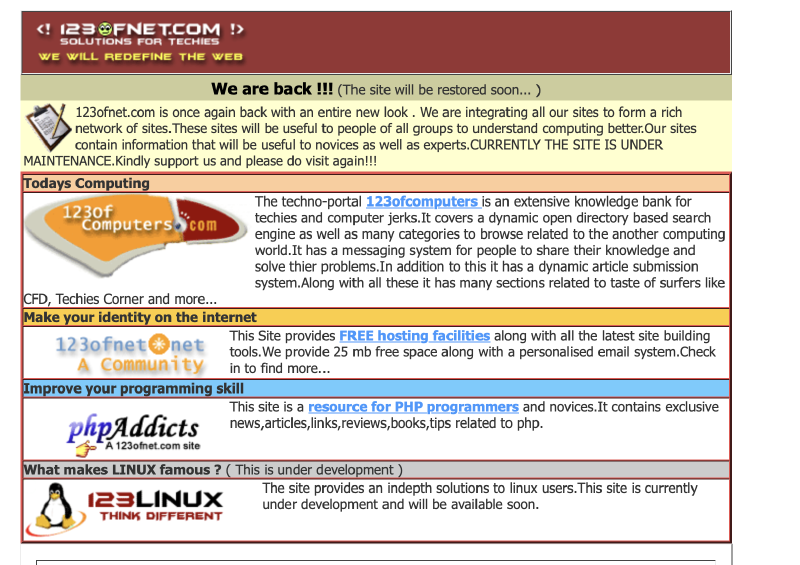
Look at the architecture in that screenshot. It’s not one site. It’s a network. Five years before “multi-vertical” became a startup buzzword, before the word “ecosystem” colonized tech, I had a parent property (123ofnet.com) federating four sub-properties:
- 123ofcomputers — techie portal, the one we’ll cover next
- 123ofnet.net — free hosting, 25 MB per user with personalized email (this was Hotmail-tier generous in 2001)
- phpAddicts — a resource site for PHP developers (PHP was the hottest server-side language; this was a deliberate vertical play)
- 123Linux — Linux solutions, “currently under development”
The strategy was instinctive, not theorized: pick a domain you can defend (computing), then own every adjacent niche. Each sub-site fed the others. The parent site was a router.
I didn’t know it then, but I had built a small portal company.
2001: 123ofcomputers.com — A Definitive Guide to Computing
By 2001 I’d outgrown what 123ofnet could be as a single page. I split out the techie content and built it into its own destination. Here is what visitors saw:
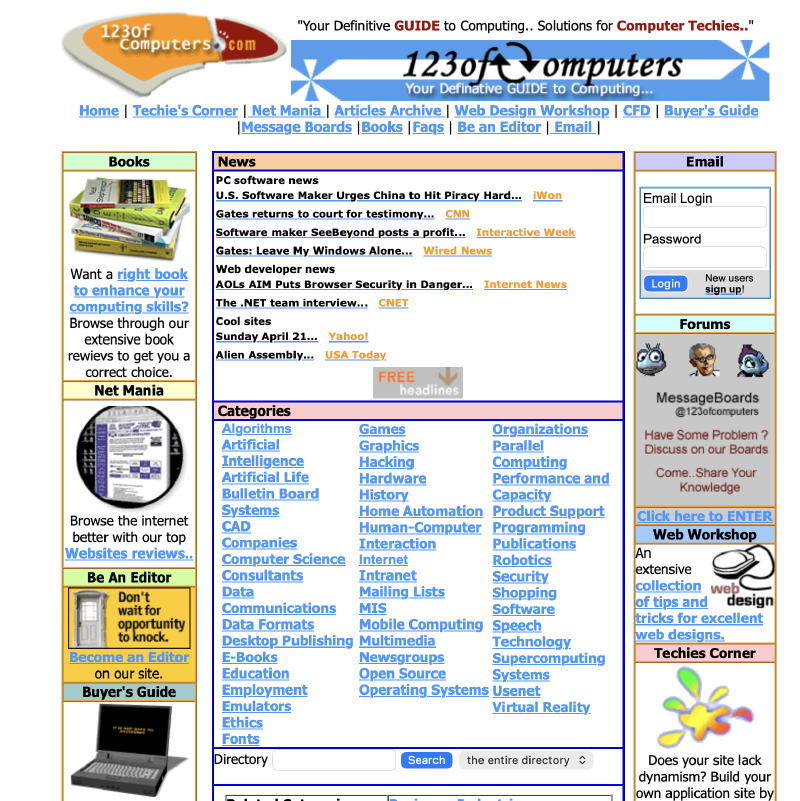
This screenshot is, as far as I can tell, the only surviving artifact of 123ofcomputers.com. The Wayback Machine has zero crawls of the domain. None. I checked the CDX index four ways. It existed, served traffic, was loved by a small community — and the Internet’s official memory has no record of it. I have this image, and that’s it.
Read the page in that screenshot like an archaeologist. Every element is a position on what the web was supposed to be in 2001:
- News aggregation row at the top — links labeled
iWon,CNN,Interactive Week,Wired News,CNET,Yahoo!,USA Today. I was a one-person Techmeme, hand-curating the day’s tech headlines five years before Techmeme launched (2005). - The category directory in the middle — Algorithms, Artificial Intelligence, Artificial Life, Bulletin Board Systems, CAD, Companies, Computer Science, Consultants, Data Communications, Data Formats, Desktop Publishing, E-Books, Education, Employment, Emulators, Ethics, Fonts, Games, Graphics, Hacking, Hardware, History, Home Automation, Human-Computer Interaction, Internet, Intranet, Mailing Lists, MIS, Mobile Computing, Multimedia, Newsgroups, Open Source, Operating Systems, Organizations, Parallel Computing, Performance and Capacity, Product Support, Programming, Publications, Robotics, Security, Shopping, Software, Speech Technology, Supercomputing Systems, Usenet, Virtual Reality. Fifty topics. Hand-categorized. This was the Yahoo Directory model at vertical depth, applied to computing.
- Message Boards — community before “community” was a growth metric. Forums were where everything happened. Reddit didn’t exist (founded 2005). Stack Overflow didn’t exist (2008). Discord didn’t exist (2015).
- “Be an Editor” — the entire site was open to user-generated contributions. Anyone could apply to edit a category. UGC was a novel pitch in 2001. Wikipedia had launched eight months earlier. We were both betting on the same hypothesis.
- Books sidebar — Amazon affiliate links, the dominant monetization model of the early 2000s content site. Long-tail recommendation commerce.
- Web Design Workshop — tutorials. Educational content. The original content marketing.
- Buyer’s Guide — product reviews, deal links. Wirecutter (founded 2011) before Wirecutter.
Every single one of these patterns is now its own multi-billion-dollar company. In 2001 they were all just sections on my homepage.
That’s not a brag. It’s a structural observation: when the medium is young, every viable model is colocated, because nobody knows yet which one is the standalone business. The market eventually unbundles. The unbundling is the business.
What was actually hard in 1997
To set context for everything below, here is what shipping a personal website meant in 1997, in India:
- Owning a domain cost real money — about $70/year through Network Solutions, which had a near-monopoly. There was no Namecheap (founded 2000), no Cloudflare Registrar, no GoDaddy land-grab yet.
- Internet access was dial-up modems over copper phone lines. Speeds of 14.4–33.6 kbps. Latency to US-hosted sites was 400–800 ms. Each page load was a deliberate act.
- Browsers were a war zone — Netscape Navigator 4 vs. Internet Explorer 4 vs. Opera. Most CSS was advisory. JavaScript was a single, single-threaded interpreter that crashed if you looked at it wrong.
- There was no Stack Overflow. No
npm. No GitHub (founded 2008). If you had a question, you posted to Usenet’scomp.infosystems.www.authoring.htmland hoped someone replied within 48 hours. - Hosting was hand-managed. You either rented shared hosting (cheap, fragile, “uploaded via FTP”) or you ran a personal Linux server out of a college computer lab. There was no AWS. No Heroku. No “deploy to Vercel.”
- Search engines were directories. Yahoo’s homepage was a curated list of categories you clicked into. AltaVista and HotBot were the dominant search engines, and they ranked by keyword density and meta tags. Google’s PageRank paper was published in 1998 and Google didn’t dominate until 2001–2003.
- Most people in your life had not seen a website. When I told my parents what I was doing, the question wasn’t “what is your business model” — it was “what is a website.”
The artifact in that screenshot — a 50-category portal, with news, forums, books, tutorials, and a buyer’s guide — required FrontPage, HTML, JavaScript, server-side includes (this was pre-PHP for me at first; later I went deep on PHP and built phpAddicts because of it), free hosting, and an absurd amount of patience.
I shipped this from India, when broadband was a phrase you read about in Wired, not something you had.
Why these sites died
Both sites went quiet between 2003 and 2005. The Wayback Machine confirms it — the snapshots of 123ofnet.com from 2002–2003 shrink to 475–600 bytes, which is the size of an “under construction” notice or a redirect. By 2005 there’s a 255-byte snapshot, which is essentially a tombstone.
Three things killed the model:
1. Google’s PageRank ate the directory. Between 2001 and 2004, Google quietly took over how people found things on the web. A 50-category portal becomes obsolete the moment a search bar can read your mind. Yahoo Directory itself, the canonical example of the model I was emulating, was shut down by Yahoo in 2014. DMOZ — the Open Directory Project — was shuttered in 2017.
2. The dot-com crash starved the ad market. The banner ads that funded HyperMart-hosted sites, the affiliate revenue from Amazon books, the modest revenue I made — all of it was crushed in 2001. Free hosting providers like HyperMart went out of business or pivoted. Many small portal sites couldn’t afford the upgrade to paid hosting once the freebies disappeared.
3. The community moved. Forums lost to Reddit (2005). Q&A lost to Stack Overflow (2008). News aggregation lost to Digg, then Hacker News, then Twitter. Every individual section of my homepage was unbundled, and each piece migrated to a dedicated platform with better tools.
So I let the sites go, and I went and did other things.
What if I had kept building?
This is the question worth sitting with — because the answer is not “I’d be rich.”
The honest answer is: the 1997–2001 model would have died regardless. A 50-category, human-curated computing directory in 2026 is a fossil. There’s no version of “keep doing exactly what I was doing” that makes sense. The portal-as-aggregator is a dead category.
But there is a version of what would have happened that’s much more interesting, and it goes like this:
Scenario A: The Authority Domain
If I had continuously updated 123ofcomputers.com from 2001 through 2026 — even just monthly — the domain itself would be a fortress. Domains compound link equity. A 25-year-old domain with continuous content history, even modest, would rank in Google for most “what is X” computing queries above any startup founded after 2015. Old PageRank is a real moat, and it’s the moat almost no founder under 35 has ever experienced.
Scenario B: The Specialist Voice
If I had narrowed the focus instead of broadening it — picked one topic (say, AI, or Linux, or computer security) and authored it as a person, not a directory — I would have built something closer to Daring Fireball (John Gruber, started 2002) or Stratechery (Ben Thompson, started 2013). The shape that survived from the early-2000s blog era wasn’t the multi-section portal. It was the single-author, narrow-vertical voice. Those sites are still standing. Most of them are profitable.
Scenario C: The Community That Outlasted
If I had doubled down on the Message Boards part of 123ofcomputers and let everything else atrophy, I might have ended up with something Reddit-shaped before Reddit existed. The hard problem with this scenario isn’t technical; it’s social. Communities need a host, and hosts burn out in two to four years on average. Sustaining a community for 25 years requires either a paid team (which I didn’t have) or a culture that hosts itself (which is rare).
Scenario D: The Pivot To AEO
Here’s the one I find most interesting. The model I built in 2001 — human-curated knowledge, organized by topic, written so it can be navigated by an outside system — is literally what AI engines need now.
LLMs don’t read SEO. They read structure. They read clean, categorized, source-attributed knowledge. They reward the same things a 2001 directory rewarded: clear taxonomy, semantic categories, internal cross-linking, and quality of authored content. The model I was building in 2001, which Google killed, is exactly the model AI is bringing back — except now the audience isn’t humans, it’s machines.
This is what I work on now. AEORank — my current company — measures how well a site is structured for AI Engine Optimization. The instinct that built 123ofcomputers is the same instinct that built AEORank, twenty-five years apart. The medium changed twice (Google, then LLMs). The job — organize knowledge so a non-human system can find what matters — didn’t change at all.
The meta-lesson
The screenshots embarrass me a little. The typography is rough. The layout is table-driven. The tagline has a typo. The color scheme is whatever HyperMart’s defaults were. None of it is what I’d ship today.
But I look at it now and the thing I notice isn’t the rough edges. It’s the posture. The site is opinionated, ambitious, and operating at the limit of its tools. In 2001 I was trying to do everything the medium could possibly do, because nobody yet knew what the medium was. That’s what every founder I respect is doing right now in AI.
The tools change. The shape of the site changes. The platforms come and go. The fact that you, the builder, want to organize the world for other people — that does not change. It’s the only thing that doesn’t.
Some things I take from looking at those two screenshots:
- Build before you know what you’re building. I had no thesis. I had energy and a category list. The thesis came later, by walking.
- Old domains are a moat almost nobody talks about. If you have a 15+ year old domain that’s still indexed, don’t let it die. Even one post a quarter compounds.
- The aggregation model dies; the authored voice survives. Of every section on my 2001 homepage, the one that has the longest half-life is the editorial one — the “Articles Archive” and “Web Design Workshop.” Tutorials and essays still earn their keep in 2026. Directories don’t.
- Every pattern returns, addressed to a different audience. The portal model died for humans in 2003 and came back for AI agents in 2024. The right move is to recognize the pattern, not to be loyal to the audience it originally served.
- Ship things you’ll be embarrassed by in 25 years. The 2001 site is rough. The 1997 site has a typo in its tagline. I’m glad they exist. The version of me that worried about polish wouldn’t have shipped any of it, and there’d be nothing to write about today.
I don’t know what 2051 looks like. I do know that the website I’m publishing this essay on — vinpatel.com, built on Hugo with a 2025 design language — will look as dated to that version of me as 123ofcomputers does now.
That’s the right outcome. That’s what shipping looks like.
If you have old screenshots of sites you used to run, dig them up. You’ll learn something about yourself.