The Real Lesson From 'AI Gives Great Financial Advice'
A viral HN thread on AI financial advice reveals the real bottleneck isn't the model — it's the prompt, and that's a product design problem.
The signal: A HackerNews thread claiming AI financial advice is “surprisingly good” — if you ask the right questions — hit 284 points today, easily the top engagement signal across HN, ProductHunt, and GitHub trending combined.
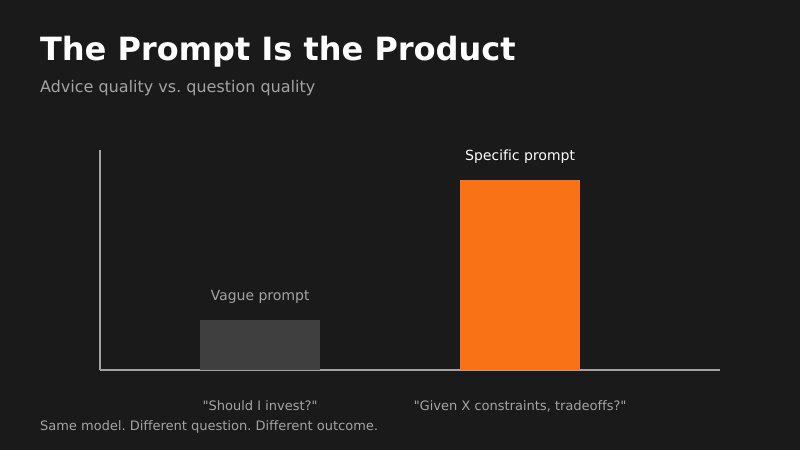
Why it matters: This isn’t really a story about finance — it’s a story about prompt design as product design. The gap between “AI gives bad advice” and “AI gives great advice” is almost entirely in how the question gets framed, and that’s a skill most end users don’t have and most products don’t teach them. If you’re building anything advisory — legal, medical, career, financial — this thread is a live case study in why raw chat interfaces underperform structured ones. Even today’s other trending signals, from a best-of-K training approach to a beginner AI curriculum on GitHub, point the same direction: leverage right now sits in how humans and models interact, not in the models themselves.
Is the AI actually smarter, or are the questions doing the work?
The questions are doing the work — that’s the real finding buried in this thread, and it’s the more important one. People getting great financial advice weren’t using a smarter model; they were front-loading context, naming constraints, and asking for tradeoffs instead of answers. This mirrors what we’ve seen with coding assistants, legal research tools, and therapy bots all year: once a model crosses a baseline competence threshold, output quality collapses almost entirely to prompt quality. The model isn’t the bottleneck anymore — the interface between human intent and machine capability is.
The pattern I’m watching: Every “AI is surprisingly good at X” thread this year traces back to the same root cause — someone did the prompt engineering the product should have done for them. We keep treating this as a user education problem when it’s actually an unsolved product design problem. The teams that win the next wave of vertical AI apps won’t have better models than everyone else — they’ll have better default questions baked into their UX, invisible to the user.
What I’d do with this: If you’re building in any advisory space, stop shipping a blank chat box and start shipping a structured intake flow that asks the good questions on the user’s behalf. Instrument what “good prompts” look like in your domain, then bake that scaffolding directly into the product so users get expert-level output on their first try instead of their fifth. Treat prompt scaffolding as a defensible feature and a moat, not a documentation footnote or a tips page nobody reads.
Key takeaways
- The quality gap in AI advice is mostly a prompting gap, not a model capability gap.
- Products that hide prompt engineering behind structured intake flows will outperform raw chat interfaces in advisory categories.
- Vertical AI winners will be defined by better default questions baked into the product, not by access to better underlying models.