SQLite CVEs or LLM Slop? Open Source Security Hits a Wall
A viral SQLite CVE debate exposes a bigger problem: AI-generated vulnerability reports are outpacing maintainers' ability to verify them.
The signal: A viral HN thread is dissecting whether a fresh batch of “critical” SQLite CVEs are real vulnerabilities or LLM-generated noise dressed up as security research.
Why it matters: If maintainers can’t tell real CVEs from AI-hallucinated ones without burning hours triaging, the disclosure pipeline itself breaks down. Builders shipping on SQLite — which is basically everyone, it’s in your phone, your browser, your app — need to know whether to patch now or ignore the noise. This is the security equivalent of the AI-slop code review problem, except the stakes are CVE databases instead of pull requests.
Is this really an LLM slop problem hitting open source security?
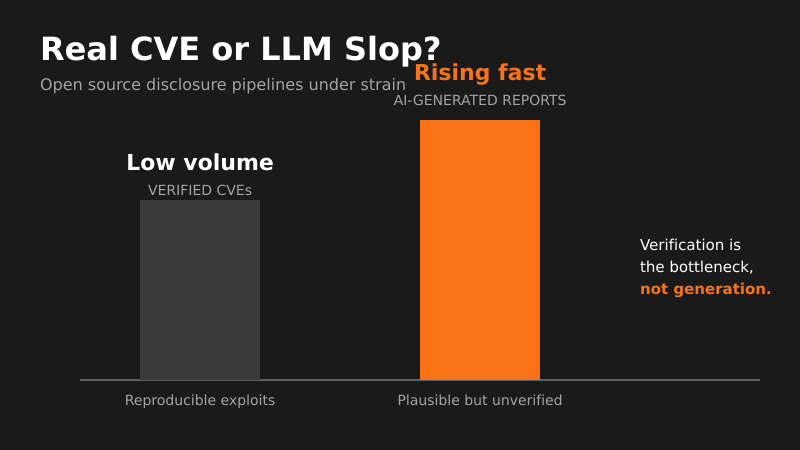
Yes — and SQLite is just the most visible flashpoint of a pattern that’s been building for months. Maintainers of major open source projects have already reported a surge in AI-generated vulnerability submissions that look plausible, cite real code paths, and turn out to be fabricated or non-reproducible. The tell is usually consistent: technically fluent language, a CVE-shaped structure, zero working exploit. When the SQLite thread blew up, it wasn’t really about SQLite’s code quality — it was about whether the disclosure process can survive being flooded with reports that look real enough to demand human review every single time.
The pattern I’m watching: This is the security-research version of “cognitive debt,” another story trending today about developers manually retyping LLM-generated code just to actually understand it. Same root problem in both cases: AI generates plausible-looking artifacts — code, CVEs, PRs — faster than humans can verify them, and verification, not generation, is now the real bottleneck. Expect this to hit every open source project with a bug bounty or CVE pipeline next, not just SQLite.
What I’d do with this: If you maintain anything with a disclosure process, add a triage gate that requires a working reproduction script before a report enters your CVE pipeline — no exploit, no ticket. If you’re a downstream consumer of SQLite or similar, don’t patch on vibes; check the actual NVD status and reproduction evidence before you touch prod. And if you’re using AI to help with security research, disclose it upfront — it’ll save everyone the credibility hit later.
Key takeaways
- A viral HN debate is asking whether new SQLite CVEs are legitimate or AI-generated slop, and the answer matters because SQLite runs in nearly every device on earth.
- Open source maintainers are increasingly flooded with AI-generated vulnerability reports that look real but don’t hold up under reproduction.
- The fix is process, not vibes: require a working exploit before any CVE report enters a triage pipeline.
- This is the same underlying problem as AI-generated code you can’t trust without manual verification — generation has outpaced verification everywhere AI touches.