Self-Driving Cars Don't Need Bigger Brains, CMU-Drive Argues
CMU-Drive and V2V-VLA argue self-driving cars should reason together, not alone — but the paper ships a benchmark, not a fleet on the road.
Everyone assumes autonomous driving is a solved-by-one-brain problem: better cameras, better lidar, a smarter model bolted onto a single car. CMU-Drive and its companion model, V2V-VLA, argue the opposite.
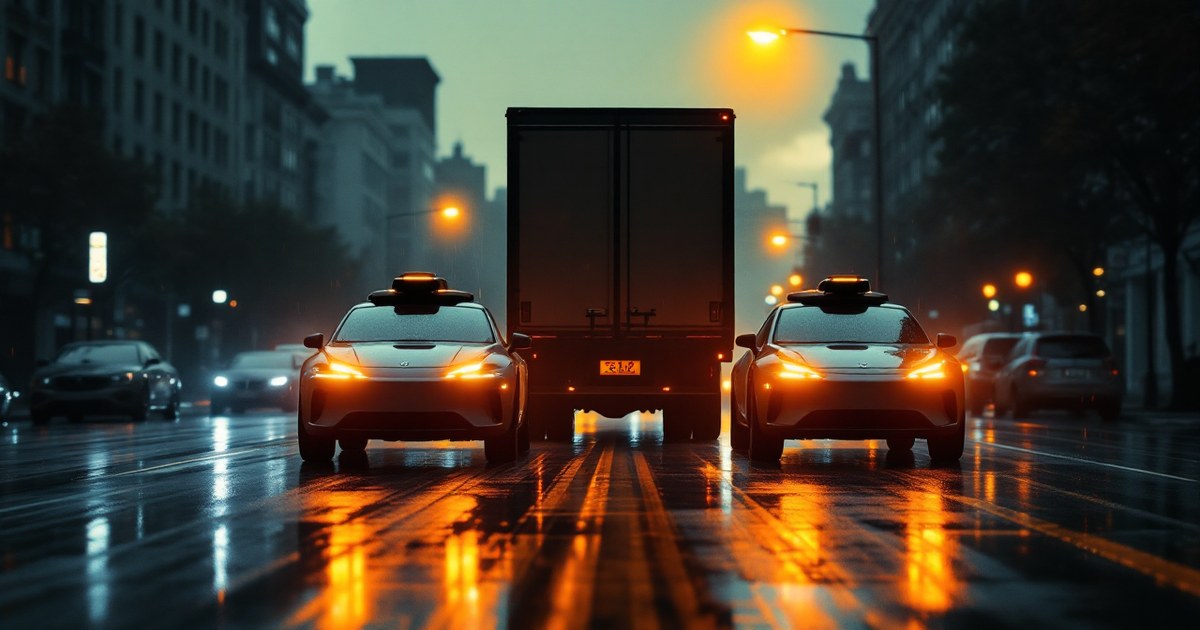
The paper’s premise is that a car reasoning alone always runs into the same wall — occlusion, blind spots, the moment a truck blocks the intersection you can’t see around — and the fix isn’t a better single-agent model. It’s cars that talk to each other, sharing vision-language-action reasoning across vehicles in real time, cooperating instead of each guessing alone. That’s the claim: cooperative multi-agent driving, tested against a new reasoning benchmark, CMU-Drive, built specifically because existing self-driving benchmarks only ever score one car at a time.
What’s measurable today is the benchmark and the framework itself — a way to test whether vehicle-to-vehicle vision-language-action models actually reason better together than apart. It is not a fleet on the road. It is not a regulatory filing. It is a research artifact: a benchmark and a model architecture published to arXiv, meant to give the field a shared yardstick for a problem nobody had a yardstick for before.
The gap between that claim and a car that actually merges lanes because another car radioed it a hazard is an infrastructure gap, not a modeling gap. Vision-language-action models can be trained to reason cooperatively in simulation. Getting two different manufacturers’ cars to share that reasoning on a real highway means a communication standard, low-latency vehicle-to-vehicle hardware already installed, and competitors agreeing to let their cars talk to each other’s models at all. None of that is a machine learning problem. It’s the coordination problem that has stalled most V2V standards for years — the modeling case gets made before the industry agrees to move together.
What would actually close the gap isn’t a bigger benchmark score inside the paper’s own test set. It’s independent replication of CMU-Drive’s results by a team that didn’t build the benchmark, and at least one case of two different vehicle platforms exchanging VLA reasoning in a live, non-simulated intersection. Benchmark gains have a way of not surviving contact with someone else’s hardware — the same pattern that shows up whenever a lab reports an agentic task jump that a third party can’t reproduce without the original team’s own guardrails, as the Forge agentic-benchmark work shows.
If cooperative driving becomes the next front for multi-agent reasoning, the orchestration layer underneath matters more than the leaderboard number — the same layer this site has been tracking in agentic software development.
None of this hits your roadmap this week unless you build automotive systems. But it previews the next multi-agent argument in AI: whether models that share reasoning beat models that reason alone, and whether the industry agrees to let them talk before a regulator forces the standard on everyone. One AI signal a day. 90 seconds. No fluff. Subscribe at /subscribe/.