Running 70B Models on a Single GPU Just Got Real
AirLLM's trending surge signals a shift: builders want to run huge models on consumer hardware, not just rent cloud GPUs.
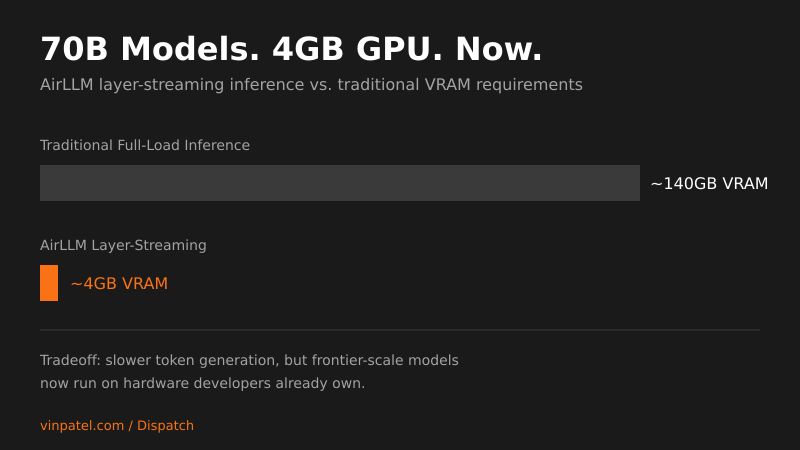
The signal: AirLLM — a library that lets you run 70B-parameter LLMs on a single 4GB GPU via layer-by-layer inference — is spiking on GitHub trending alongside Microsoft’s AI-For-Beginners repo.
Why it matters: For years, running a serious open-weight model meant either renting an A100 cluster or settling for a quantized toy version. AirLLM’s approach — streaming model layers to disk/GPU on demand instead of loading the whole thing into VRAM — means a developer with a gaming laptop can now run inference on models that used to require enterprise infrastructure. That’s not an incremental win, it’s a shift in who gets to experiment with frontier-scale open models.
Does this actually change what solo developers can build?
Yes — it moves the bottleneck from hardware access to patience, since layer-streaming trades speed for memory footprint. You’re not fine-tuning in real time or serving low-latency production traffic off a 4GB card, but you can now prototype, test prompts, and validate that a 70B model behaves the way you expect before committing to expensive cloud inference. That’s a meaningful unlock for indie builders and researchers who’ve been priced out of experimenting with the largest open-weight releases. The tradeoff is real: expect inference in seconds-per-token territory, not the snappy responses you get from a hosted API. But for evaluation, fine-tuning experiments, and offline batch jobs, that tradeoff is often worth it.
The pattern I’m watching: This is the second wave of local-LLM tooling — the first wave (llama.cpp, quantization) made small models fast on consumer hardware, and this wave is making large models possible on consumer hardware, even if slow. Pair that with Microsoft’s beginner-friendly AI curriculum trending in the same window, and you get a clear signal: the barrier to entry for both learning AI and running AI is collapsing simultaneously. When accessibility tools trend together like this, it’s usually because a new cohort of builders is entering the space at once.
What I’d do with this: If you’ve been holding off on testing a 70B+ open model because you didn’t want to spin up cloud GPUs, clone AirLLM this week and benchmark it against your actual use case — not a demo prompt. Use it for offline evaluation and fine-tuning experiments where token-per-second speed doesn’t matter, and keep your production inference on dedicated infrastructure. If you’re mentoring junior engineers or hiring, point them at AI-For-Beginners as a filter — anyone who’s worked through it arrives with real vocabulary, not buzzwords.
Key takeaways
- AirLLM lets developers run 70B-parameter models on consumer GPUs with as little as 4GB of VRAM by streaming model layers instead of loading full weights into memory.
- The speed-for-memory tradeoff makes AirLLM better suited for offline evaluation and experimentation than for production, low-latency inference.
- Rising interest in both large-model accessibility tools and beginner AI education signals a new wave of builders entering the space with lower hardware and knowledge barriers.
- Teams evaluating open-weight models should test locally before committing to cloud inference costs, since local streaming inference can validate model behavior for free.