qm's Multiplayer Pitch Signals Agents Becoming Shared Infrastructure
qm's 'multiplayer agent harness' trending on HN signals a shift from solo AI coding sessions to shared, auditable team infrastructure.
The signal: qm, described as a “multiplayer agent harness for work,” is the top story on Hacker News today — pitching AI agent sessions as shared, persistent workspaces instead of single-user CLI runs.
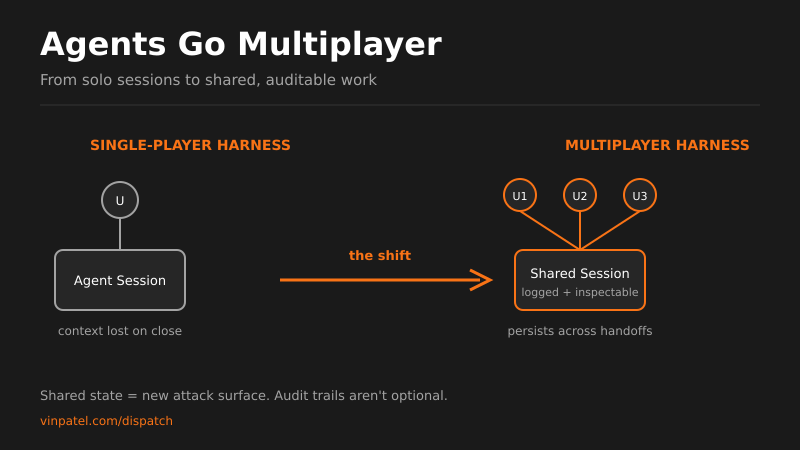
Why it matters: Most agent harnesses you’re already using — Claude Code, Cursor’s agent mode, Aider — are single-player: you spin up a session, the agent works, you close the terminal, and the context is gone. qm’s “multiplayer” framing suggests agent sessions should be shared objects a team can join, inspect, and steer together, like a live doc instead of a private terminal. If that model catches on, it changes how teams structure agent work — less “my AI pair programmer,” more “our AI teammate with a paper trail.”
Does multiplayer mean agents finally work like shared infrastructure?
Yes — that’s the entire pitch, and it’s overdue. Right now, agent sessions live in one developer’s terminal or IDE tab, so context, decisions, and intermediate output evaporate the moment that person closes their laptop or gets pulled into a meeting. A multiplayer harness treats the session itself as a persistent, inspectable object — something a teammate can drop into mid-task, review what the agent already tried, and redirect it without starting from zero. That’s the missing piece between “impressive solo demo” and “tool a team actually relies on.” It’s also a tacit admission that agent output needs the same visibility and handoff mechanics as any other shared engineering artifact.
The pattern I’m watching: Security and coordination are converging on the same infrastructure question. Today’s other big HN story — Tailscale didn’t stop a Hugging Face intrusion — is a reminder that whatever plumbing lets agents or humans share state also becomes an attack surface, no matter how trusted the network layer looks on paper. Multiplayer agent harnesses will need the same scrutiny you’d give shared SSH access or a team Slack bot with repo write permissions, not a pass because it’s labeled “AI tooling.”
What I’d do with this: If you’re evaluating agent tooling for a team, ask about handoff, session logging, and access control before you ask about model quality — those are the parts that break trust first. Treat shared agent session state exactly like you’d treat a shared terminal: log everything, gate who can join or steer it, and assume it will eventually be probed by someone who shouldn’t have access.
Key takeaways
- Multiplayer agent harnesses shift AI coding sessions from single-user tools into shared, persistent team infrastructure.
- Any system that lets multiple humans or agents share live session state also becomes a new access-control and audit surface.
- The Tailscale–Hugging Face intrusion story is a live reminder that trusted network layers don’t guarantee endpoint or session security.
- Teams adopting shared agent tooling should demand handoff logging and audit trails before scaling usage, not retrofit them after an incident.