qm's Multiplayer Agent Harness Signals a New Dev Shift
qm's multiplayer agent harness tops HN today, marking a shift from solo AI coding tools to coordinated, team-scale agent orchestration.
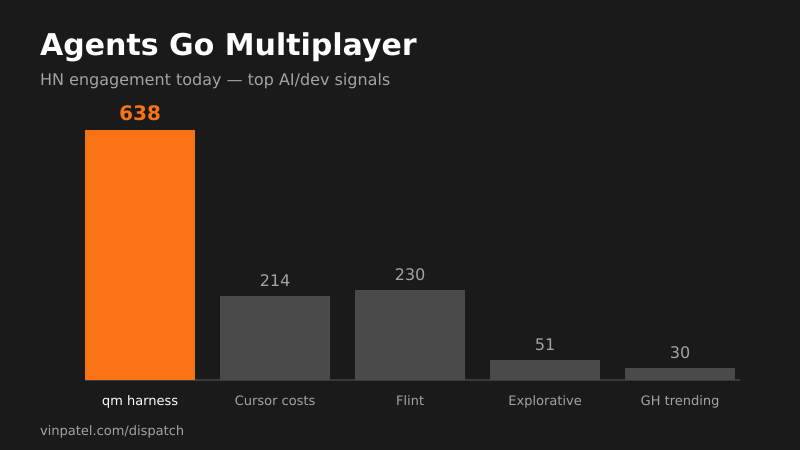
The signal: qm, a “multiplayer agent harness” built for coordinating AI agents on real work, rocketed to the top of Hacker News today with 638 points — more than double every other trending AI story combined.
Why it matters: Every serious dev tool of the last two years has been built for one human, one agent, one terminal. qm is the first widely-noticed attempt to make multiple agents (and possibly multiple humans) share context, state, and task ownership in the same workspace. If it works, it’s the missing layer between “I have Claude Code running” and “my team has an agent workforce.” That’s a different product category than autocomplete or single-session chat, and it’s the category every infra builder should be watching right now.
Does this mean AI coding tools are becoming team infrastructure instead of personal tools?
Yes — qm’s traction is the clearest evidence yet that the center of gravity is moving from individual agent sessions to shared, multiplayer coordination layers. Solo agent harnesses (Cursor, Claude Code, Aider) solved the one-person-one-agent loop; the next unsolved problem is state and task-sharing across multiple agents working the same codebase or workflow simultaneously. That’s a much harder distributed-systems problem — locking, conflict resolution, shared memory — dressed up as a dev tool. HN’s 638-point reaction says builders feel this gap acutely, not just curiously.
The pattern I’m watching: Agent tooling is bifurcating into two tracks — polished, monetized, increasingly opaque consumer tools (see Cursor quietly pulling cost data from its usage page today, a move that should worry anyone budgeting agent spend) and raw, open, infrastructure-first experiments like qm that expose the hard problems instead of hiding them. The teams that win the next cycle will be the ones building the coordination layer, not just a nicer chat window on top of an LLM.
What I’d do with this: Spin up qm on a non-critical repo this week and specifically stress-test what happens when two agents touch the same file or task queue — that’s where the real product gap will show. Separately, if you’re on Cursor and tracking agent spend, export your usage data now, before more cost visibility quietly disappears.
Key takeaways
- qm’s 638-point HN showing signals real developer appetite for multi-agent coordination, not just curiosity about a new tool.
- The hard unsolved problem in agentic coding right now is shared state and task ownership across multiple agents, not single-agent capability.
- Cursor removing cost visibility from its usage page is a reminder that agent tooling economics are getting less transparent as the market matures.
- Builders should treat multiplayer agent harnesses as early-stage infrastructure bets, not finished products, and test them on low-stakes repos first.