OpenClaw + Ollama: The 'Fully Autonomous' Claim Doesn't Ship
An arxiv paper pairs OpenClaw with Ollama to pitch fully autonomous agents — here's what actually matters for builders shipping agent systems.
The signal: A new arxiv paper trending today pairs OpenClaw with Ollama to pitch a blueprint for “fully autonomous and scalable” AI agent systems.
Why it matters: Ollama is real, widely-deployed infrastructure — local model serving that plenty of production teams already run to cut inference cost and latency. The paper’s framing, “fully autonomous,” is exactly the language that drives citations and hype cycles, not necessarily the kind that survives a real deployment. Builders should care because local-inference agent stacks are quietly becoming the default architecture for cost-sensitive teams, and this paper is a signal of where that conversation is heading next, not proof that autonomy problem is solved.
Does “fully autonomous” agent architecture actually ship?
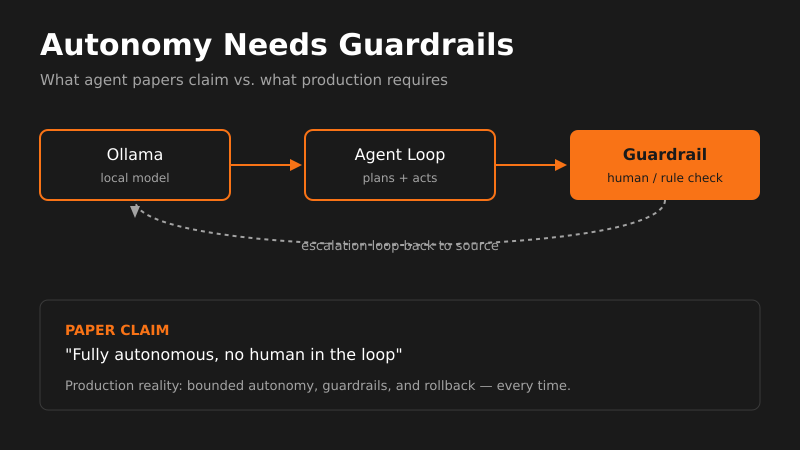
No — not in the way the title implies. In production, autonomy means bounded autonomy inside guardrails, not open-loop self-direction. Every agent system I’ve watched ship in the last year converges on the same shape: cheap local inference (Ollama, vLLM) for grunt work, a stronger model for judgment calls, and a human or hard rule as the circuit breaker. Academic papers get to define “autonomous” as “completed the task without intervention during the demo.” Production has to survive a bad tool call, a hallucinated API signature, or a rate limit at 2am — a different bar entirely. The genuinely useful part of this paper isn’t the autonomy claim; it’s that Ollama keeps showing up as the reference local-inference layer in agent architectures, which tells you where tooling consensus is forming.
The pattern I’m watching: Local-first inference is becoming the default substrate for agent papers and real agent products alike, because token cost and latency kill agent loops that call a hosted API for every micro-decision. Line this up with the other signals today — devs manually retyping LLM code to fight “cognitive debt,” a UI library shipped by a trading firm, AI reviewing AI research papers — and the throughline is skepticism finally catching up with hype. The industry is quietly building the habits and guardrails it should’ve had a year ago.
What I’d do with this: Treat this paper as a pointer to architecture, not a spec — steal the Ollama-as-local-executor pattern, skip the “fully autonomous” framing entirely. Go read the actual implementation details, not the abstract, and stress-test any autonomy claim against a real failure mode before you trust it. Spend your engineering hours on observability and rollback for agent actions — that’s where production agent systems actually die, not in the orchestration loop.
Key takeaways
- Local-inference tools like Ollama are becoming the default substrate for agent architectures in both academic papers and production systems.
- “Fully autonomous” in an arxiv title almost always means no human in the loop during the demo, not in production.
- The real engineering work in agent systems is guardrails, observability, and escalation paths, not the orchestration loop itself.
- A paper pairing a new framework with an established tool like Ollama is a useful signal of where tooling consensus is forming, even when its core claim is oversold.