Local Agents Are Learning to Judge Each Other
OpenClaw + Ollama push autonomous agent stacks local, while AI-evaluating-AI research signals a coming trust problem for builders.
The signal: A fresh arxiv paper on OpenClaw and Ollama for building fully autonomous, scalable agent systems is trending alongside three other papers about AI systems evaluating, benchmarking, and reviewing other AI systems.
Why it matters: If you’re shipping agentic products, the stack is quietly shifting toward local-model orchestration — Ollama as the inference layer, OpenClaw-style frameworks as the coordination layer. That’s a real cost and latency win. But the cluster of “can AI evaluate AI” papers dropping the same week is a warning sign: the field is building autonomy faster than it’s building trustworthy ways to check that autonomy actually worked.
Should you build agentic systems on local models right now?
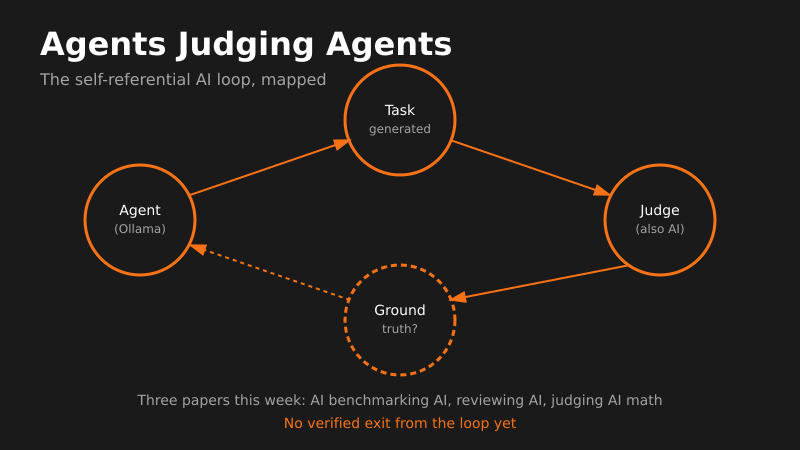
Yes, for prototyping and internal tools — no, not yet for anything customer-facing that needs guaranteed correctness. Ollama has made local model serving genuinely production-adjacent: fast cold starts, decent quantization support, and now frameworks like OpenClaw wrapping it in agent loops instead of raw chat completions. The catch is evaluation. Three separate papers this week are wrestling with the same unsolved problem — using LLMs to judge LLM output, whether that’s grading a research paper, scoring a math conjecture, or reviewing an autonomous agent’s reasoning chain. Until that judging layer is solid, autonomous agent output needs a human in the loop, full stop.
The pattern I’m watching: Every layer of the agent stack is going self-referential — agents generating research, agents reviewing that research, agents scoring other agents’ math proofs. That’s efficient in theory, but it’s also a closed loop with no ground truth outside the system, and closed loops are exactly where silent failure modes hide. The frog-with-a-Habsburg-jaw SVG benchmark making the HN front page isn’t a joke — it’s a reminder that simple, human-verifiable tests still catch failures that elaborate multi-model review pipelines miss.
What I’d do with this: Pull Ollama plus an OpenClaw-style agent loop into a side project this week and time it against your current API-based agent — measure latency, cost, and failure rate on tasks you can verify by eye. Keep your evaluation dead simple (a human spot-check, a fixed test suite, something like the frog benchmark) instead of trusting an LLM judge you haven’t stress-tested yourself. If you’re doing anything with memory-constrained inference, check out airllm on GitHub — it’s trending for a reason and pairs well with this local-agent direction.
Key takeaways
- Ollama plus agent frameworks like OpenClaw are making local, autonomous agent stacks practical enough to prototype this month, not just research.
- A wave of papers using AI to evaluate AI — benchmarking research, reviewing agents, judging math conjectures — signals the field has an evaluation trust gap, not a capability gap.
- Simple, human-verifiable benchmarks like an SVG frog test still catch real failures that complex multi-model review systems can miss.
- Builders should prototype agentic loops locally now but keep evaluation dead simple until AI-judging-AI methods prove reliable.