LLMs Don't Replace Expertise, They Weaponize It
A top HN thread argues LLMs widen the gap between experts and novices instead of closing it — and today's dispatch explains why that changes how you hire, mentor, and ship code.
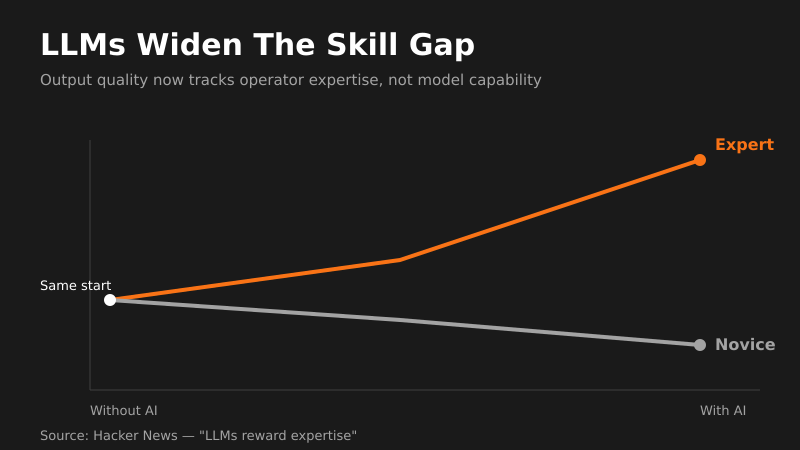
The signal: A top Hacker News thread crystallizes a claim that’s been rattling around dev Slack channels for a year: LLMs don’t flatten the skill curve between experts and beginners — they steepen it.
Why it matters: If you already know how a system should behave, an LLM is a force multiplier — it drafts, refactors, and explores options faster than you could alone, and you catch its mistakes instantly. If you don’t know what correct looks like, the model hands you plausible-sounding garbage with the same confidence it hands an expert the right answer, and you have no way to tell the difference. That asymmetry is starting to show up in hiring, in code review queues, and in how teams structure who gets to use AI tools unsupervised.
Does AI actually make junior developers more productive?
Not by itself, and the HN thread is basically a room full of senior engineers saying so out loud. The pattern people describe: juniors ship code faster with Copilot or Claude, but the code carries subtle bugs, wrong assumptions, or architecture that doesn’t scale — because catching those requires the exact judgment the junior hasn’t built yet. Seniors report the opposite experience: they use the same tools to compress hours of boilerplate into minutes, because they can review output in seconds and know exactly what to check. The tool is identical in both cases. The output quality tracks the operator’s prior expertise, not the model’s raw capability.
The pattern I’m watching: This is the same argument buried in the “retyping LLM-generated code to prevent cognitive debt” thread trending today — both are reactions to the same discovery, that fluency with AI output is a skill you can atrophy or never build if you let the model do your thinking. The industry spent two years selling LLMs as a skill equalizer, the great leveler that would let anyone code, write, or analyze like an expert. The builders actually shipping with them are quietly discovering the opposite: a skill amplifier that punishes anyone using it as a substitute for judgment rather than as leverage on top of it.
What I’d do with this: If you’re hiring or mentoring, stop measuring AI-assisted output volume and start measuring review speed — how fast someone can tell a good AI suggestion from a bad one is the real skill you’re paying for now. If you’re early-career, don’t let the model write things you can’t yet explain line by line; the retyping-the-code crowd is onto something, and manual repetition is still how judgment gets built. If you’re senior, this is the best moment in your career to be a fast, opinionated reviewer with strong priors — that’s exactly what an LLM can’t fake for you.
Key takeaways
- LLMs amplify existing expertise more than they replace it, which means the skill gap between experts and novices is widening, not closing.
- Junior developers ship faster with AI tools but often can’t catch the subtle errors those tools introduce, because catching errors requires judgment they haven’t built yet.
- The real bottleneck in AI-assisted work is review speed — how fast you can separate a good model output from a convincing bad one.
- Manually re-deriving AI-generated code or answers is an underrated way to build the judgment that makes AI tools actually useful later.