Gemini Robotics 2 Signals the End of Bespoke Robot Stacks
Google's Gemini Robotics 2 brings whole-body intelligence to robots, collapsing years of bespoke control stacks into one foundation model.
The signal: Google’s Gemini Robotics 2 dropped this week with “whole body intelligence” — a single model coordinating full robot bodies instead of just arms and grippers — and it’s the top story on Hacker News today.
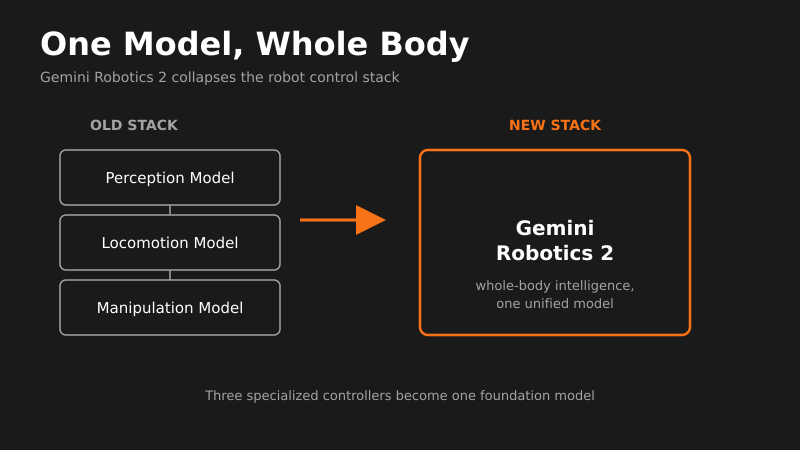
Why it matters: For 15 years, robotics has been a graveyard of bespoke controllers: one stack for locomotion, another for manipulation, a third for perception, glued together by engineers who never sleep. A foundation model that handles whole-body coordination collapses that stack into something closer to how LLMs collapsed NLP pipelines. If you build automation, logistics, or physical-world products, the interface you’ll be coding against in 18 months looks a lot more like a prompt than a state machine.
Does whole-body intelligence actually change what robots can do?
Yes — it moves robots from single-task specialists to systems that generalize across a body’s full range of motion using one model instead of a dozen. Historically, a robot that could walk couldn’t necessarily manipulate objects with the same model; you stitched together separate perception, planning, and control systems for each subsystem. Whole-body intelligence means the model reasons about the entire physical system at once — legs, arms, balance, grip — the same way a multimodal LLM reasons across text, image, and audio in one pass. That’s the actual unlock: not a smarter robot, but a radically simpler stack behind it.
The pattern I’m watching: This is the same consolidation arc we watched happen to search, to coding, to customer support — foundation models absorbing domains that used to require specialized engineering teams. Robotics was the last holdout because physical control has real-world failure costs text generation doesn’t. Google shipping this alongside Chrome’s AI-driven bug fixes and a GCC AI policy in the same week tells you the absorption isn’t slowing down — it’s hitting infrastructure-level software too.
What I’d do with this: If you’re building anything touching physical automation — warehouse ops, home robotics, field hardware — stop investing in custom control stacks and start prototyping against foundation model APIs now, even if they’re not production-ready. The teams that win this cycle will be the ones who treated Gemini Robotics 2 as an SDK on day one, not the ones who waited for a stable release. It’s also worth reading the mixed-motive multi-agent misalignment paper trending alongside this — once robots run on shared foundation models, multi-agent deception research stops being theoretical.
Key takeaways
- Gemini Robotics 2 introduces whole-body intelligence, letting one model coordinate a robot’s full physical system instead of stitching together separate control stacks.
- Foundation models are now consolidating robotics the same way they consolidated search, coding, and customer support over the past three years.
- Builders in physical automation should prototype against foundation model robotics APIs now rather than investing further in bespoke control architecture.