Apple's Ex-Employee Data Claims Against OpenAI Widen
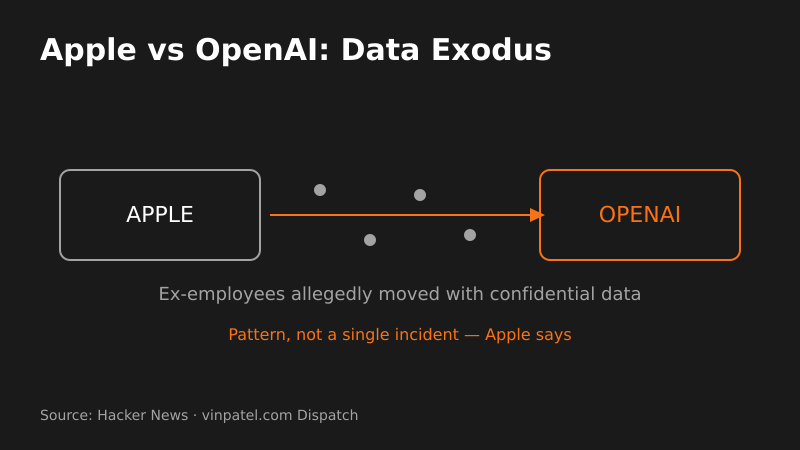
Apple now alleges a pattern of ex-employees taking confidential data to OpenAI, turning a single dispute into a legal fight over AI talent and IP.
The signal: Apple’s legal team is now alleging a broader pattern — more former employees may have walked out the door with confidential data before landing at OpenAI, expanding what looked like an isolated incident into something resembling a pipeline problem.
Why it matters: For builders, this is a live case study in what happens when the talent war between AI labs turns adversarial. If Apple’s claims hold up, every engineer who’s ever jumped to a competitor with “just some notes” in their head is watching how this plays out — and so is every legal team drafting the next NDA. IP leakage isn’t a hypothetical compliance slide anymore; it’s a live legal battleground between two of the most valuable companies on earth.
Does this change how engineers should think about moving between AI labs?
Yes — the bar for what counts as “confidential” is about to get a lot more aggressive, and engineers moving to competitors should assume everything they touched is discoverable. Apple isn’t accusing one person of theft; it’s alleging a pattern, which means discovery will likely pull in Slack messages, laptop images, and personal cloud drives from multiple former employees. That’s a different legal posture than a single trade-secret dispute — it looks like an attempt to set a precedent that chills lateral moves into OpenAI specifically. Any engineer with sensitive IP exposure fielding recruiter calls from frontier labs should be talking to a lawyer before they talk to HR.
The pattern I’m watching: This is one of several “talent move turns into litigation” stories this year involving frontier AI labs, and it converges with a bigger trend: the actual product of these companies is increasingly the people, not just the models. When compute is commoditized and model capability converges, the differentiator becomes the tacit knowledge sitting in a handful of engineers’ heads — which is exactly why companies now sue over it.
What I’d do with this: If you’re hiring senior engineers from Apple, Google, or Meta right now, get legal ahead of the offboarding process — clean device wipes, documented data-return procedures, the works — because you don’t want your new hire to become your legal liability. If you’re the engineer, over-document what you’re leaving behind, not just what you’re taking.
Key takeaways
- Apple is expanding its claims against former employees who moved to OpenAI, suggesting a pattern rather than an isolated incident.
- Frontier AI labs are increasingly competing over people, not just models, because tacit knowledge is the real moat once model capability converges.
- Engineers moving between AI labs should assume broader legal discovery and stricter IP scrutiny than in a typical job change.
- Companies hiring from competitors need airtight offboarding and onboarding documentation to avoid absorbing legal risk along with talent.