Agents Go Multiplayer: Why Solo AI Coding Isn't Enough
qm's HN breakout signals a shift from solo AI coding agents to multiplayer agent harnesses built for real team workflows.
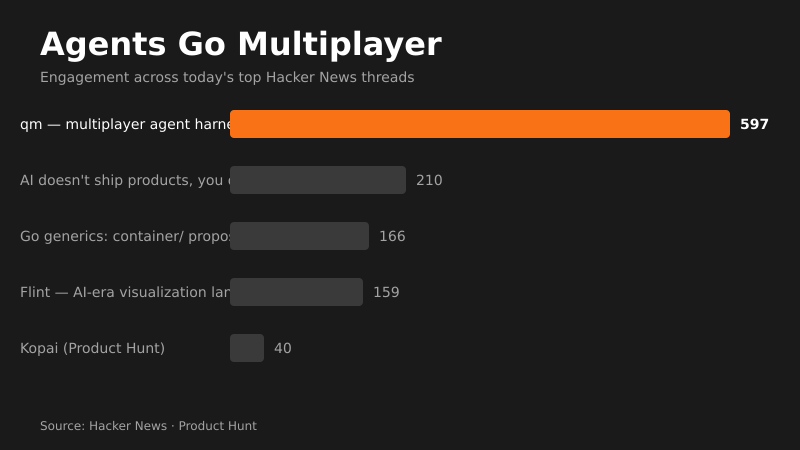
The signal: qm, a “multiplayer agent harness for work,” is dominating Hacker News today with engagement that dwarfs everything else on the front page.
Why it matters: Almost every agent tool shipped in the last two years is single-player — one dev, one terminal, one context window. qm is built around the idea that multiple agents (and multiple humans) share the same session state instead of each spinning up an isolated instance. If that model sticks, it changes how teams structure agent-assisted work from “spawn five terminals and hope” to something with actual coordination and handoffs.
Does this mean solo-agent coding tools are obsolete?
No — but they’re clearly incomplete, and today’s HN thread is proof builders are hitting the coordination wall before they hit the intelligence wall. The other trending post today, “AI doesn’t generate working products, that’s still your job,” is the other half of the same argument: agents generate code fine, they just don’t own outcomes, sequencing, or conflict resolution across a team. A multiplayer harness is an attempt to make that ownership structural instead of manual, which is a different bet than just shipping a smarter single model. Solo agents win on individual velocity; multiplayer harnesses are trying to win on team throughput, and those are not the same problem.
The pattern I’m watching: Every infrastructure signal today — generic collection types in Go, a new visualization language for AI output, a multiplayer agent harness — is really about building primitives for agent-native workflows instead of one-off scripts. We’re past the “can an agent write this function” phase and into the “how do ten agents and three humans not collide” phase, which is a much harder and much more interesting problem.
What I’d do with this: If you’re building agent tooling, stop optimizing single-agent context windows and start building the shared-state layer — that’s the primitive that ends up owning the workflow. Pull qm into a real multi-person, multi-task sprint this week instead of a toy demo, and pay attention to exactly where handoffs between agents break, because that’s where the next product opportunity is.
Key takeaways
- qm’s HN traction shows builders are now optimizing for agent coordination, not just agent intelligence.
- Solo-agent coding tools solve individual velocity, but they don’t solve team-level throughput or ownership of outcomes.
- The next wave of AI infrastructure is shared-state and orchestration primitives, not smarter single models.